Electric vehicle manufacturers face a fastening challenge that traditional automotive production never had to solve: joining thin aluminum panels to house a battery pack that must stay sealed, cool, and structurally sound for the life of the vehicle. CD stud welding answers that challenge directly. Because the process fuses a stud to a metal surface in milliseconds without marking the opposite side, it gives EV manufacturers the clean, strong, repeatable connections that battery enclosures require. As EV production scales up across the automotive industry, CD stud welding has moved from a niche technique to a core assembly method. Northland Fastening Systems supplies the equipment and expertise that make this shift possible.
Why EV Manufacturing Needs a Different Fastening Approach
Traditional combustion vehicles rely heavily on bolts, rivets, and adhesives to join body panels. However, EV battery enclosures introduce new demands. Manufacturers must protect sensitive cells from moisture, dust, and vibration while keeping the enclosure lightweight enough to preserve range. Consequently, every fastening point becomes a potential failure risk if it isn’t executed with precision.
Bolted connections require drilled holes, and drilled holes create weak points where corrosion and moisture intrusion can begin. Stud welding eliminates that risk entirely. Since the weld forms from one side only, technicians never compromise the enclosure’s sealed surface. As a result, manufacturers gain a fastening method that supports both structural integrity and environmental protection.
How CD Stud Welding Works on Thin Aluminum Panels
Capacitor discharge welding stores an electrical charge and releases it in a fraction of a second. This burst of energy melts the tip of the stud and a small area of the base metal, and the stud then fuses permanently to the surface. Because the entire cycle completes in one to three milliseconds, the surrounding metal barely heats up.
This speed matters enormously for EV production. Aluminum battery trays and enclosure panels run thin, often under two millimeters, and excess heat can warp or discolor them. CD Studs handle this challenge well because they transfer minimal heat while still creating a bond stronger than the base material itself. Therefore, manufacturers avoid the distortion and burn-through that other welding methods risk on thin gauge aluminum.
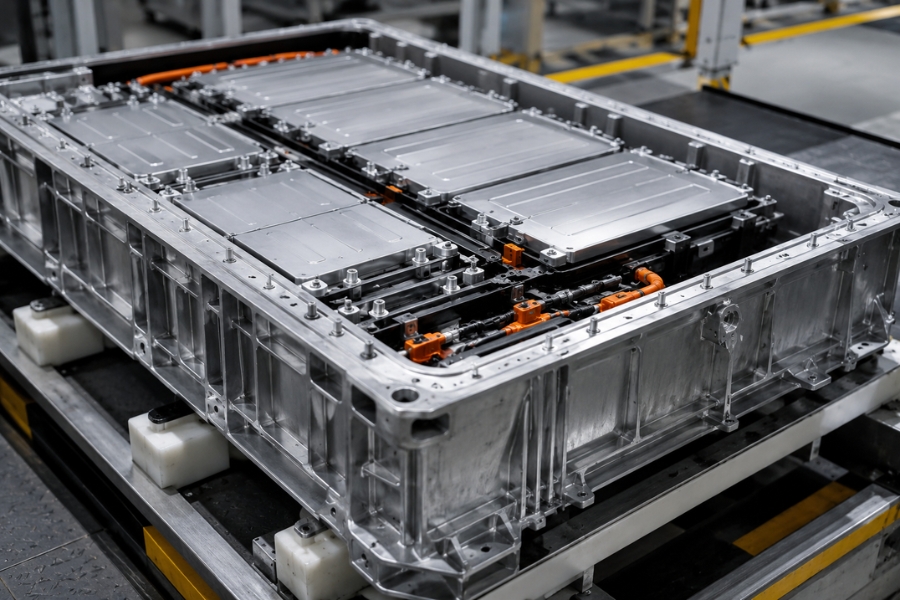
Battery Enclosures: The Toughest Test for Precision Fastening
Battery enclosures endure conditions that most automotive components never face. They must resist water and dust intrusion at levels comparable to IP67 or higher, withstand road vibration for the vehicle’s lifetime, and maintain a stable internal environment for temperature-sensitive cells. Every fastening decision either supports these requirements or undermines them.
Because CD stud welding leaves no exit-side marking, manufacturers can mount brackets, cooling plates, and internal supports without breaching the enclosure’s outer seal. In turn, the finished enclosure maintains the ingress protection rating it was engineered to meet. This is precisely why battery enclosure production has become one of the fastest-growing applications for capacitor discharge welding in the automotive sector today.
Speed and Consistency on the Production Line
EV manufacturers operate on tight production timelines, and every second of cycle time affects overall output. CD stud welding supports high-volume lines because a single machine can complete dozens of welds per minute without sacrificing quality. Additionally, the process integrates smoothly into robotic and CNC-controlled systems, so Automation becomes a natural extension of the welding station rather than a separate investment.
Automated CD welding cells also reduce variability between welds. Since the machine controls voltage, timing, and pressure consistently, every stud meets the same specification regardless of shift or operator. Manufacturers therefore gain both speed and repeatability, two qualities that matter just as much to EV assembly as strength does.
What Automotive Manufacturers Should Look for in a Supplier
Not every stud welding provider understands the tolerances that EV production demands. Manufacturers should look for a supplier that offers studs engineered specifically for aluminum and mixed-metal applications, equipment calibrated for thin-gauge production, and technical support that understands automotive quality standards. Northland Fastening Systems brings decades of stud welding expertise to exactly these requirements, supplying the tools, studs, and guidance that automotive fabricators need to keep pace with EV production demands.
Get the Right Fastening Partner for Your EV Production Line
Stay connected with the latest fastening solutions, industry updates, and EV manufacturing insights through our Google Business Profile and Facebook page. Follow us to learn more about CD stud welding, battery enclosure fastening, and solutions designed for modern automotive production.
For help selecting the right CD studs, equipment, and accessories for your EV or automotive production needs, call (651) 730-7770 or request a quote online to get started.
Frequently Asked Questions
Why is CD stud welding better than bolting for EV battery enclosures?
CD stud welding creates a weld from one side only, so it never breaches the enclosure’s sealed surface. Bolting requires drilled holes, which introduce points where moisture and corrosion can enter.
Can CD stud welding work with thin aluminum used in EV panels?
Yes. The process generates heat for only a few milliseconds, so it avoids the warping and burn-through that longer welding cycles cause on thin aluminum.
Is CD stud welding suitable for automated EV production lines?
Absolutely. CD stud welding integrates easily with robotic and CNC systems, allowing manufacturers to maintain consistent weld quality at high production speeds.
Does CD stud welding work on dissimilar metals used in EV assemblies?
Yes. CD stud welding successfully joins studs to a range of metals, including aluminum, stainless steel, and mild steel. Therefore, manufacturers can fasten components across different material types within the same battery enclosure without switching processes.