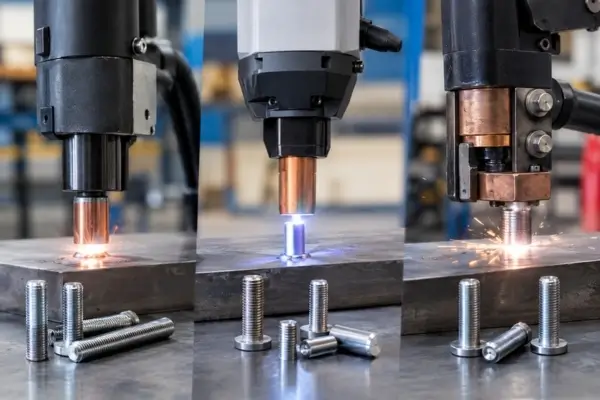
Stud welding is not a single method; it is a family of processes, each engineered for a specific range of applications, base material thicknesses, and production requirements. Choosing the right process before you order studs or equipment is one of the most important decisions your team will make for any project. Northland Fastening Systems stocks products for all three main stud welding processes—arc, capacitor discharge, and short cycle—and this page provides a clear, practical breakdown of each, so you can identify the right fit for your application before placing your first order.
Understanding the differences between these processes saves time, reduces material waste, and prevents costly rework on the job site. Each process produces a permanent weld but the stud diameter, base material thickness, and application environment determine which one delivers the right result. A structural bridge deck program has completely different requirements from a food service equipment fabrication line, and the wrong process choice affects everything from weld strength to surface finish. The sections below break down each process clearly so your team can move forward with confidence before the first order is placed.
Drawn Arc Stud Welding
Drawn arc stud welding is the most widely used process for structural and heavy industrial applications. It joins a metal stud to a base material by generating a sustained electric arc between the two melting both surfaces and creating a full cross-sectional bond when the stud plunges into the molten pool.
How It Works
The operator loads the stud into the welding gun chuck and positions a ceramic ferrule around the stud base. When the trigger fires, the gun lifts the stud slightly off the base material, drawing a pilot arc. The DC power supply then generates the main arc heating both the stud tip and the base metal to a molten state. The gun plunges the stud into the pool, the weld solidifies in milliseconds, and the ceramic ferrule contains and shapes the weld flash. The ferrule is removed after the weld cools, leaving a permanent, full-strength connection. For operations running high-volume structural programs, stud welders with digital controls and programmable arc parameters ensure this cycle repeats consistently across every weld point.
Key Specifications
- Stud diameter range: 3/16″ to 1-1/4″
- Weld cycle time: 0.06 to 1.5 seconds depending on diameter
- Base material minimum thickness: approximately 1/3 of stud diameter
- Materials: mild steel, stainless steel, aluminum
- Certification: meets AWS D1.1 structural welding requirements
Best Suited For Structural steel fabrication, composite bridge deck construction, headed anchor and shear connector installation, construction equipment manufacturing, and any application requiring AWS-certified structural connections.
Products Used Arc studs in threaded, headed anchor, shear connector, and deformed bar anchor configurations. Ceramic ferrules matched to stud diameter. Adjustable chucks, cable connectors, and arc accessories for the welding gun.
Capacitor Discharge (CD) Stud Welding
Capacitor discharge stud welding uses stored electrical energy charged in capacitors before the weld cycle begins to generate a brief, high-intensity arc. The entire weld cycle completes in as little as 0.01 seconds, which means minimal heat input, no burn-through on thin materials, and no visible marking on the reverse side of the base material.
How It Works
The CD process uses two techniques depending on the application. In the contact method, the stud is placed directly against the base material. When the trigger fires, current discharges through the stud’s ignition tip, vaporizing it and creating the arc that fuses both surfaces. In the gap method, the stud is lifted to a small gap above the surface before the discharge fires. Both techniques complete the weld in milliseconds with the same result — a clean, precise bond with minimal heat spread.
Key Specifications
- Stud diameter range: #8 to 1/2″
- Weld cycle time: 0.003 to 0.01 seconds
- Base material minimum thickness: 0.020″ (0.5mm)
- Materials: mild steel, stainless steel, aluminum
- No ferrule required
Best Suited Sheet metal fabrication, electrical enclosure manufacturing, food service equipment production, insulation fastening, signage, cookware, and any application where surface appearance on the reverse side of the material must remain unmarked.
Products Used Arc studs in flanged, non-flanged, and small-flanged configurations in mild steel and stainless steel. CD weld pins for insulation anchoring and panel attachment. CD accessories including contact feet, gap feet, and collet inserts matched to stud diameter.
Short Cycle Stud Welding
Short cycle stud welding sits between drawn arc and CD in terms of process speed and heat input. It uses the same basic arc-and-plunge sequence as drawn arc welding but operates at significantly shorter arc durations typically 10 to 100 milliseconds without the use of a ceramic ferrule. Instead, shielding gas protects the weld zone during the arc phase.
How It Works
The stud loads into the gun and the gun positions against the base material. When the trigger fires, the lift-and-arc sequence begins but at a much faster cycle than standard drawn arc. Inert shielding gas floods the weld zone in place of the ceramic ferrule, preventing oxidation during the arc phase. The stud plunges and the weld solidifies. Because no ferrule is used, the process is faster to set up and produces less post-weld cleanup than drawn arc but it requires tighter process control to achieve consistent results.
Key Specifications
- Stud diameter range: 3/16″ to 1/2″
- Weld cycle time: 0.01 to 0.1 seconds
- Base material: thicker than CD applications, thinner than typical drawn arc
- Shielding gas required: typically 100% argon or argon/CO2 mix
- No ceramic ferrule required
Best Suited For Medium-gauge steel and stainless steel applications where CD cannot generate sufficient energy and drawn arc produces too much heat input. Common in automotive component manufacturing, HVAC equipment, and industrial enclosure fabrication where speed and moderate stud diameter range are both required.
Process Comparison: Which One Do You Need?
| Factor | Drawn Arc | CD | Short Cycle |
|---|---|---|---|
| Stud diameter range | 3/16″ to 1-1/4″ | #8 to 1/2″ | 3/16″ to 1/2″ |
| Base material thickness | Medium to heavy | Thin to very thin | Thin to medium |
| Weld cycle time | 0.06 to 1.5 seconds | 0.003 to 0.01 seconds | 0.01 to 0.1 seconds |
| Ferrule required | Yes | No | No |
| Reverse-side marking | Possible on thin material | None | Minimal |
| AWS structural certification | Yes, D1.1 / D1.5 | Not applicable | Not applicable |
| Typical industries | Structural steel, bridge, construction | Sheet metal, food service, enclosures | Automotive, HVAC, medium gauge |
| Shielding gas required | No (ferrule used instead) | No | Yes |
Use this table as your starting point. If your application falls across more than one column for example, a program using both structural arc studs and thin sheet metal CD pins confirm your requirements with a product specialist before placing your order.
Not Sure Which Process Your Application Needs?
Northland Fastening Systems carries products for all three stud welding processes — drawn arc studs, CD studs, CD weld pins, stud welding accessories, and all compatible equipment in the full range of diameters, lengths, and material grades your project requires.
Our team works directly with fabrication shops, structural contractors, project managers, and purchasing departments to confirm the right process and product match for each application. We do not fill generic catalog orders, we verify your requirements and make sure every order ships correctly from the first shipment.
Call us at 651-730-7770 to speak with a stud welding product specialist today. You can also browse our full product range online and request a quote directly from any product page.
Frequently Asked Questions
Q1: What is the main difference between drawn arc and CD stud welding?
Drawn arc uses a sustained electric arc and a ceramic ferrule to produce full cross-sectional structural welds on medium to heavy base materials. CD uses stored capacitor energy for an extremely fast weld cycle under 0.01 seconds on thin materials with no reverse-side marking. The two processes serve different applications and are not interchangeable.
Q2: Can I use CD welding for structural applications?
No. CD stud welding does not produce the weld penetration depth or cross-sectional bond area required for structural certification under AWS D1.1. Structural applications require drawn arc stud welding with ceramic ferrules and AWS-compliant stud materials.
Q3: What shielding gas does short cycle stud welding require?
Short cycle stud welding typically uses 100% argon or an argon/CO2 mix. The shielding gas protects the weld zone from oxidation during the arc phase in place of the ceramic ferrule used in drawn arc welding.
Q4: How do I know which stud diameter range my application requires?
Stud diameter depends on the load the connection must carry, the base material thickness, and the process type. For structural applications, your project engineer specifies the required diameter in the structural drawings. For sheet metal or light fabrication, base material thickness and appearance requirements typically guide the selection. Call our team at 651-730-7770 and we will confirm the right diameter for your specific application.