Northland Fastening Systems helps manufacturers choose fastening solutions that match their materials, production needs, and application requirements. When manufacturers evaluate a stud welding process selection, they should always start with the base material thickness.
Thickness directly affects heat transfer, weld penetration, stud compatibility, and joint strength. Therefore, manufacturers cannot use the same welding approach for every sheet or plate. Instead, they need to match the welding process and stud design to the material.
For example, thin sheet metal can react quickly to heat. Meanwhile, thicker materials can absorb more energy before they reach the required welding temperature. As a result, the correct process, equipment settings, and product selection can improve weld consistency and reduce production problems.
How Thickness Changes the Welding Process
Base material thickness influences how quickly heat moves through the workpiece. Thin material transfers heat differently from heavy plates, so welding parameters must account for that difference.
First, consider the amount of heat required to create a reliable weld. A thin sheet may need controlled energy to prevent excessive heating, distortion, or surface damage. In contrast, thicker material may require more energy to create adequate fusion.
Next, consider the stud size. A larger stud generally requires a suitable weld area and sufficient base material to support the connection. Therefore, manufacturers should evaluate stud diameter, weld collar design, material thickness, and application load together.
In addition, surface condition can affect the final weld. Clean and properly prepared surfaces allow the welding process to create a more consistent connection.
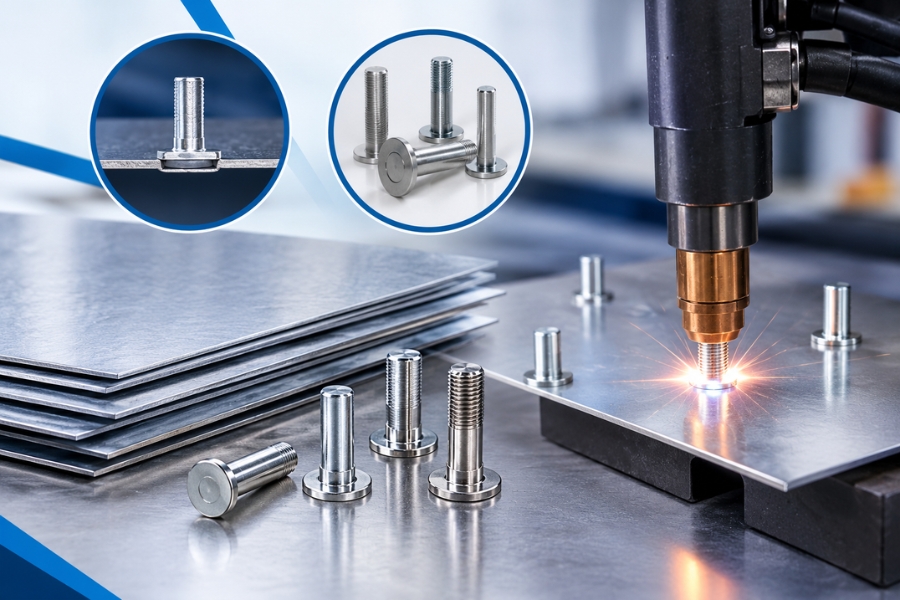
Thin Materials and CD Studs
CD Studs often suit applications that use thinner sheet metal and require controlled heat input. Capacitive discharge welding releases stored electrical energy over a very short period. As a result, the process can create a localized weld while limiting overall heat exposure.
This characteristic makes CD studs useful for many sheet metal applications. Manufacturers can use them for panels, enclosures, brackets, covers, and other components where excessive heat could cause unwanted distortion.
Moreover, the short welding cycle can support fast production. Operators can place studs quickly and maintain repeatable results when they use the correct equipment, settings, and materials.
However, manufacturers should not select CD studs based only on sheet thickness. They should also consider the stud diameter, base material, required strength, weld position, and final application.
Thicker Materials and Stud Welding Processes
Stud Welding Processes that use drawn arc technology can support applications that require greater heat input and deeper weld penetration. These processes can work effectively with thicker base materials because they create a controlled arc between the stud and workpiece.
As the process continues, the arc melts the contact area. The equipment then drives the stud into the molten weld pool, which forms the connection as the material cools.
Consequently, drawn arc processes can support heavier brackets, structural components, equipment frames, and other applications that place greater demands on the welded joint.
Still, manufacturers must match the process to the actual material thickness. They should also consider stud diameter, weld length, material type, and required mechanical performance before finalizing the process.
How Product Selection Depends on Thickness
Material thickness should guide product selection from the beginning. First, determine the base material type and thickness. Then, identify the stud diameter and thread requirements.
After that, evaluate the expected load. A stud that supports insulation does not face the same demands as a stud that secures a structural bracket.
Manufacturers should also review the backside of the material. Thin sheet metal can show heat effects more easily, while thicker material can tolerate greater heat input.
Furthermore, production speed can influence the decision. High-volume manufacturing requires repeatable processes that maintain quality without creating unnecessary production delays.
For this reason, Northland Fastening Systems can help manufacturers consider the complete application instead of focusing on material thickness alone. The right combination of stud, welding process, equipment, and settings can improve consistency across repeated assemblies.
Avoid Common Thickness-Related Welding Problems
Manufacturers can prevent many welding issues by reviewing the application before production begins.
For example, using excessive heat on thin material can increase the risk of distortion. On the other hand, insufficient energy on thick material can prevent the weld from developing the required connection.
Similarly, an unsuitable stud size can create an imbalance between the fastener and the base material. Therefore, manufacturers should verify the stud design and welding parameters before beginning large production runs.
They should also test the selected setup on the actual material. Testing helps confirm weld quality and allows technicians to adjust settings before full-scale production.
Improve Your Stud Welding Process Selection
The right stud welding process selection starts with understanding the base material, thickness, heat requirements, and application needs. Consistent information across your Google Business Profile and Facebook can also help customers find and understand your stud welding solutions.
CD studs can support many thin sheet metal applications, while drawn arc welding can handle thicker materials and demanding fastening requirements. Our team can help you choose suitable stud welding products for your specific application. For more information, call (651) 730-7770.
Frequently Asked Questions
1. Why does base material thickness affect stud welding?
Material thickness affects heat transfer, weld penetration, distortion risk, and the amount of energy required to create a reliable weld. Therefore, manufacturers should consider thickness when selecting both the process and stud.
2. Are CD studs suitable for thin sheet metal?
Yes. CD studs often work well with thin sheet metal because the process delivers a short, localized electrical discharge. However, manufacturers should confirm compatibility with the specific material and application.
3. When should I consider drawn arc stud welding?
Drawn arc welding can suit thicker materials and applications that require greater weld penetration or higher joint strength. The final choice should also consider stud size, material type, and application load.
4. Can one welding process work for different material thicknesses?
A single process may handle a range of thicknesses, but manufacturers must adjust the welding parameters and select compatible studs. Testing the setup on the actual material can help confirm suitable performance.
5. What should I consider besides material thickness?
Consider the base material, stud diameter, stud length, required load, weld location, production volume, heat sensitivity, and equipment capabilities. These factors help create a suitable fastening setup.