What Are Deformed Bar Anchors?
Northland Fastening Systems provides fastening solutions for manufacturers that need dependable attachment methods for demanding applications. In particular, deformed bar anchors offer a practical way to create welded connections between reinforcing-style bars and metal components.
These anchors feature a deformed surface that can improve mechanical engagement within an application. Manufacturers can use them where a welded anchor needs additional holding capability or where the design requires a bar-style fastening component.
However, manufacturers should not select an anchor based only on its shape. Instead, they should consider the base material, bar size, weld method, load requirements, and final application. Therefore, understanding how these anchors work can help manufacturers choose a suitable fastening solution.
How Do Deformed Bar Anchors Work?
A deformed bar anchor typically uses a bar or stud with a textured or ribbed surface. The deformations increase the surface profile around the bar and can support mechanical engagement in applications where the anchor interacts with another material.
Manufacturers can weld the anchor to a suitable metal surface before using it in the final assembly. The appropriate Stud Welding Processes can create a secure connection between the anchor and base material.
As a result, the finished component can provide a reliable attachment point for applications that require anchoring, reinforcement, or load transfer.
The exact design depends on the intended use. For example, one application may require a particular bar diameter, while another may need a specific length or weld configuration.
Where Can You Use Deformed Bar Anchors?
Manufacturers can use these anchors across several industrial applications. Their design makes them useful when an assembly needs a welded bar-style attachment.
Common applications can include:
- Concrete-related metal components
- Construction equipment
- Structural assemblies
- Reinforcement components
- Industrial frames
- Metal fabrication projects
- Heavy-duty brackets
- Precast concrete applications
- Specialized anchoring systems
Furthermore, manufacturers can adapt the anchor design to match specific project requirements. They can consider dimensions, material specifications, weld compatibility, and expected loads before production.
This approach helps prevent mismatches between the anchor and the final application.
Why Does the Deformed Surface Matter?
The deformation on the bar serves an important purpose. Unlike a smooth bar, a deformed bar creates additional ridges or profiles along its length. As a result, these features can increase mechanical interaction when the bar works within a surrounding material. Consequently, the design can support applications where the anchor must resist movement or transfer forces.
However, the deformation alone does not determine overall performance. The welding method, base material, anchor dimensions, and application conditions also influence the final result.
Therefore, manufacturers should evaluate the complete assembly rather than treating the bar profile as an isolated feature.
Deformed Bar Anchors and Welding
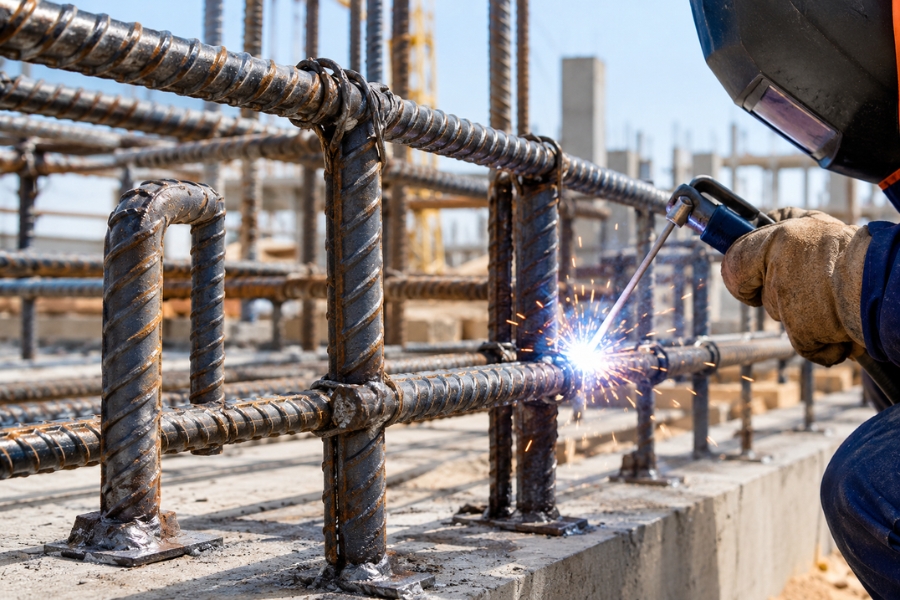
Welding plays a central role when manufacturers attach these anchors to a metal base. The selected welding method must match the anchor material, base material, dimensions, and required connection strength.
For example, CD Studs can support certain fastening applications that require controlled and localized heat input. This approach can work well when the application calls for a fast attachment process and compatible stud or fastener designs.
On the other hand, Stud Welding Processes can support applications that require different welding characteristics. Drawn arc methods, for example, can work with thicker materials and applications that require deeper weld penetration.
Therefore, manufacturers should evaluate the complete welding setup before choosing a product.
CD Studs vs. Stud Welding Processes
Although both options relate to welded fastening, their characteristics can differ significantly. The following comparison highlights 15 practical differences:
| CD Studs | Stud Welding Processes |
| Commonly used capacitive discharge technology | Can include drawn arc welding technology |
| Often suit thinner sheet metal | Can suit thicker base materials |
| Deliver energy over a very short cycle | Can use a longer controlled welding cycle |
| Produce localized heat | Can introduce greater heat into the weld area |
| Often help limit heat exposure | Can provide deeper weld penetration |
| Commonly support smaller fastening applications | Can support heavier fastening applications |
| Work well with compatible thin materials | Can handle demanding material thicknesses |
| Often suit light-duty attachment points | Designed for applications with higher load requirements |
| Help minimize heat exposure in thin sheets | Can provide stronger fusion for heavier materials |
| Support fast repetitive fastening | Support industrial welding applications |
| Use stored electrical energy | Use an arc between the stud and base material |
| Often require precise surface preparation | Also require controlled surface preparation |
| Can fit high-volume production environments | Can fit heavy-duty production environments |
| Commonly support localized attachment | Can support structural or heavy attachment needs |
| Depend on suitable stud and material combinations | Depend on suitable process and parameter combinations |
These differences do not make one approach suitable for every application. Instead, manufacturers should match the welding method to the actual material, anchor design, production requirements, and expected loads.
When Should You Use Deformed Bar Anchors?
Manufacturers should consider deformed bar anchors when an application requires a welded bar-style attachment with an additional surface profile.
First, review the required load to ensure the anchor matches the forces the finished assembly will experience.
Next, check the base material to confirm that it supports the selected welding method and provides an appropriate foundation for the connection.
Additionally, consider the anchor dimensions, since bar diameter and length can affect installation, positioning, and final performance.
Finally, review the production environment. High-volume manufacturing may require repeatable positioning and consistent welding parameters. Therefore, select a fastening solution that fits both the product and the manufacturing workflow.
Important Product Selection Factors
Several factors can influence anchor selection.
Base Material
Start by identifying the base material and its thickness. Different materials respond differently to heat and welding energy.
Anchor Dimensions
Select a bar diameter and length that match the application. A suitable size helps the anchor perform as intended without creating unnecessary material or installation challenges.
Welding Method
Choose a compatible welding process. The process should provide the required connection while matching the material thickness and production conditions.
Load Requirements
Consider the forces that the anchor will experience. Applications with greater loads may require different anchor dimensions, materials, or welding configurations.
Production Volume
High-volume production requires consistent results. Therefore, manufacturers should consider equipment compatibility, cycle time, positioning, and repeatability.
Northland Fastening Systems can help manufacturers evaluate these factors when selecting fastening products for specialized applications. A careful review can reduce product mismatches and improve production consistency.
How to Improve Welding Consistency
Manufacturers can improve welding results by controlling the variables that affect every connection. To begin with, keep the base surface clean and properly prepared, as contamination can interfere with the welding process.
In addition, maintain consistent positioning so each anchor sits in the intended location. Proper alignment also helps reduce inconsistencies during production.
Equally important, use repeatable welding parameters. Operators should follow validated settings rather than making unnecessary adjustments during production.
Finally, test the finished connection to identify potential issues before they affect a larger production run. By following these steps, manufacturers can support consistent quality and reduce avoidable production problems.
Choose the Right Anchor for Your Application
Deformed bar anchors can provide a useful fastening option when manufacturers need welded bar-style attachment points for industrial, structural, or concrete-related applications.
However, successful product selection requires more than choosing a bar with a deformed surface. Manufacturers should evaluate the base material, anchor dimensions, welding method, load requirements, and production environment together.
For example, CD welding and drawn arc processes can serve different material and application needs. Therefore, manufacturers should select the process that matches their specific requirements rather than applying one method to every project.
Northland Fastening Systems offers fastening solutions for manufacturers that need dependable products for specialized applications. Contact our team at (651) 730-7770 discuss your anchor requirements, welding process or product selection.
Frequently Asked Questions
1. What are deformed bar anchors used for?
Deformed bar anchors provide welded attachment points for applications that require a bar-style fastening component. Manufacturers can use them in structural, industrial, reinforcement, and concrete-related applications.
2. Why do deformed bar anchors have ribs or surface deformations?
The surface profile can improve mechanical interaction with surrounding materials. However, overall performance also depends on the anchor material, dimensions, welding method, and application.
3. Can you weld deformed bar anchors to sheet metal?
The answer depends on the anchor material, base material, thickness, dimensions, and selected welding process. Manufacturers should confirm compatibility before production.
4. How do I select the right deformed bar anchor?
Consider the base material, anchor diameter, length, required load, welding method, and production requirements. These factors help determine a suitable product configuration.
5. Do CD welding and drawn arc welding work the same way?
No. CD welding uses a short capacitive discharge, while drawn arc welding creates a controlled arc and can support applications requiring greater heat input and deeper penetration.