Choosing the right drawn arc stud welding equipment directly affects weld quality, production speed, and inspection results on every structural job your team runs. The wrong machine creates arc instability, inconsistent flash rings, and failed certification checks — problems that cost far more to fix than the time it takes to select the right equipment upfront. Northland Fastening Systems works with fabrication teams, construction contractors, and project managers daily to help them match the right drawn arc machine to their specific application. This guide covers every factor you need to evaluate before making that decision.
What Makes Drawn Arc Equipment Different from Other Stud Welding Systems
Drawn arc stud welding equipment operates differently from capacitor discharge systems in one critical way. It generates a sustained electric arc — typically between 100 and 2,000 milliseconds — that produces the deep heat penetration structural applications require. This makes it the only suitable process for large-diameter studs, thick base materials, and any application where AWS D1.1 structural certification is required.
Furthermore, drawn arc machines must control three variables with precision on every weld cycle: lift height, arc duration, and plunge speed. A machine that loses consistency on any of these variables produces welds that vary in penetration depth and flash ring geometry — both of which inspectors evaluate on structural programs. Therefore, the equipment you select must maintain that consistency across thousands of weld cycles, not just on the first few test welds.
Key Factors to Evaluate Before Choosing a Machine
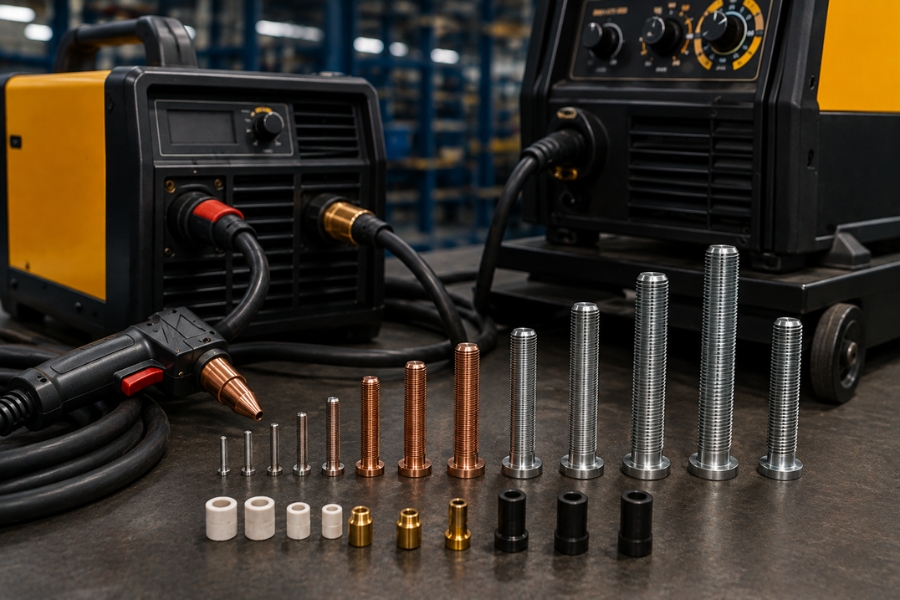
Not all drawn arc stud welding equipment suits every application. Use these criteria to evaluate any machine before committing to a purchase or rental:
Power Output and Stud Diameter Range
Power output determines which stud diameters a machine can weld reliably. The table below shows the general relationship between machine power and stud diameter capacity:
| Machine Power Output | Suitable Stud Diameter Range | Typical Application |
|---|---|---|
| Up to 400A | 3/16″ to 1/2″ | Light structural, threaded stud applications |
| 400A to 800A | 1/2″ to 7/8″ | Composite construction, shear connectors |
| 800A to 1,500A | 7/8″ to 1-1/4″ | Heavy structural, bridge deck shear connectors |
| 1,500A+ | 1″ to 1-1/4″ and above | Large-scale infrastructure, naval construction |
Match your machine’s power output to the largest stud diameter your program requires — not the average. A machine that struggles at the top of its rated capacity produces inconsistent welds under production conditions.
Portability vs. Fixed Setup
Drawn arc equipment falls into two categories. Portable machines suit job site construction, bridge work, and structural steel fabrication where the operator moves across large work areas. Fixed or bench-mounted machines suit production environments where parts come to the machine on a line or fixture.
In addition, portable machines must handle outdoor conditions — temperature variation, dust, and intermittent power supply quality. Confirm the machine’s IP rating and input power tolerance before deploying it on a job site where supply voltage may fluctuate.
Duty Cycle
Duty cycle tells you how long a machine can weld continuously before it needs to cool down. A 60% duty cycle at 800 amps means the machine can weld for six minutes out of every ten at that power level. On high-volume production programs with hundreds of welds per shift, a low duty cycle creates forced downtime that slows your entire schedule.
Consequently, always select a machine with a duty cycle that exceeds your actual production demand — not one that matches it exactly. Running a machine at its duty cycle limit consistently accelerates component wear and reduces service life.
Digital vs. Analog Controls
Modern drawn arc stud welding equipment increasingly uses digital controls with programmable weld parameters, weld data logging, and error detection. These features matter significantly on certified structural programs where weld records must be maintained for inspection.
Analog machines are simpler and more durable in harsh environments but provide no weld data output. If your program requires documented weld records — as most bridge and structural building programs do — a machine with digital controls and data output is the correct choice regardless of the added cost.
Matching the Machine to Your Application
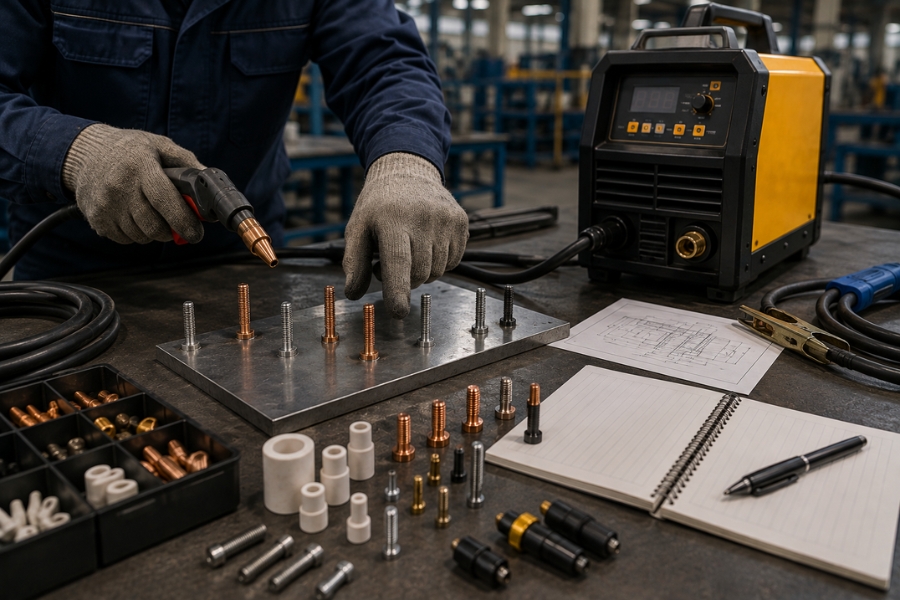
Different applications place different demands on drawn arc stud welding equipment. Here is how to match machine type to the work your team actually performs:
Bridge deck and composite construction — These programs involve large-diameter shear connectors (3/4″ and 7/8″) welded at high volume to beam flanges before concrete pours. They require high-power machines (800A+), high duty cycles, and digital weld data logging for inspection compliance.
Structural steel fabrication — Headed anchors and threaded studs in mid-range diameters (1/2″ to 3/4″) suit most fabrication shop programs. A mid-range portable or bench machine handles this work reliably. Northland Fastening Systems regularly helps fabrication shops identify the right machine for this exact application range.
Construction equipment manufacturing — This sector uses a mix of drawn arc and CD welding depending on the component. The drawn arc suits heavy structural frames and base plate connections. Confirm stud diameter requirements before selecting equipment, as some programs span a wider diameter range than a single machine handles optimally.
Site-based construction — Portable machines with wide input voltage tolerance and rugged housing suit job site environments. Furthermore, site programs often benefit from renting rather than purchasing, since equipment needs vary by project.
Should You Buy or Rent Drawn Arc Equipment?
The right answer depends entirely on how consistently you use drawn arc welding across your programs. If your operation runs structural stud welding programs continuously throughout the year, purchasing makes financial sense and typically reaches break-even within 12 to 24 months at full utilization.
If your drawn arc work is project-specific or seasonal, rentals deliver the same machine capability without the capital commitment or maintenance responsibility. A rental also gives your team access to the correct machine specification for each individual program — rather than adapting one purchased machine to every job regardless of fit.
For teams evaluating both options, consider your average annual utilization rate. If drawn arc welding occupies fewer than three full months of production time per year, renting almost always delivers lower total cost of ownership than purchasing.
Source the Right Drawn Arc Equipment from Northland Fastening Systems
We carry a complete range of stud welders for drawn arc applications — portable and fixed models across the full power output range — available for both purchase and rental. You can also connect with us through our Google Business Profile and Facebook pages for product updates and industry information. Our team works directly with project managers, fabrication supervisors, and purchasing departments to confirm the right machine specification for each application before any commitment is made.
We also supply the full range of drawn arc consumables — arc studs, ceramic ferrules, chucks, cable connectors, and all standard accessories — so your team can source equipment and supplies from one knowledgeable supplier that understands how they work together.
Contact Us at 651-730-7770 to speak with a product specialist today. We are ready to walk through your application, confirm the right machine specification, and make sure your program starts with the right equipment from day one.
Frequently Asked Questions
Q1: What power output do I need for welding 3/4″ shear connectors on a bridge deck program?
Bridge deck shear connector programs using 3/4″ studs require a machine rated at 800 amps or above with a high duty cycle. Confirm the machine maintains consistent arc duration and plunge speed across the full production volume your program demands.
Q2: Can one drawn arc machine handle all stud diameters my fabrication shop uses?
Most mid-range drawn arc machines cover 3/16″ to 7/8″ effectively. If your program regularly uses studs above 7/8″ in diameter, confirm the machine’s rated capacity at that diameter under production duty cycle conditions before purchasing or renting.
Q3: When does renting drawn arc equipment make more financial sense than buying?
Renting makes more sense when drawn arc welding is project-specific or accounts for fewer than three months of active production per year. It also suits programs where stud diameter requirements vary significantly between jobs and no single machine covers all specifications optimally.
Q4: What is the advantage of digital controls on drawn arc stud welding equipment?
Digital controls allow programmable weld parameters, consistent repeatability across operators, and weld data logging for inspection records. These features are essential on certified structural and bridge programs where documentation of weld parameters is required by the project specification.