Stud welding aluminum is one of the most misunderstood processes in the fastening industry. Many welders approach aluminum the same way they approach steel and that is exactly where problems begin. Aluminum behaves differently at every stage of the welding process. It conducts heat faster, oxidizes instantly, and demands tighter process control than steel ever does. Understanding these differences does not just improve your weld quality. It saves time, reduces rework, and protects your production schedule from costly delays.
Why Aluminum Behaves Differently from Steel
Steel and aluminum share very little in common when it comes to welding behavior. Steel holds heat at the weld zone long enough for a full, clean fusion to occur. Aluminum, on the other hand, pulls heat away from the weld point almost immediately.
This happens because aluminum has roughly four times the thermal conductivity of steel. That means the base material draws energy away from the arc faster than the weld zone can reach the temperature needed for proper fusion. Furthermore, aluminum forms an oxide layer on its surface within seconds of exposure to air. That oxide layer has a melting point nearly three times higher than the aluminum beneath it. If you weld through it without removing it first, you trap contamination directly in the weld pool.
These two properties, rapid heat dissipation and instant oxidation, create challenges that simply do not exist when you weld steel. As a result, welders who treat aluminum like steel consistently produce weak, inconsistent connections.
The Most Common Mistakes in Stud Welding Aluminum
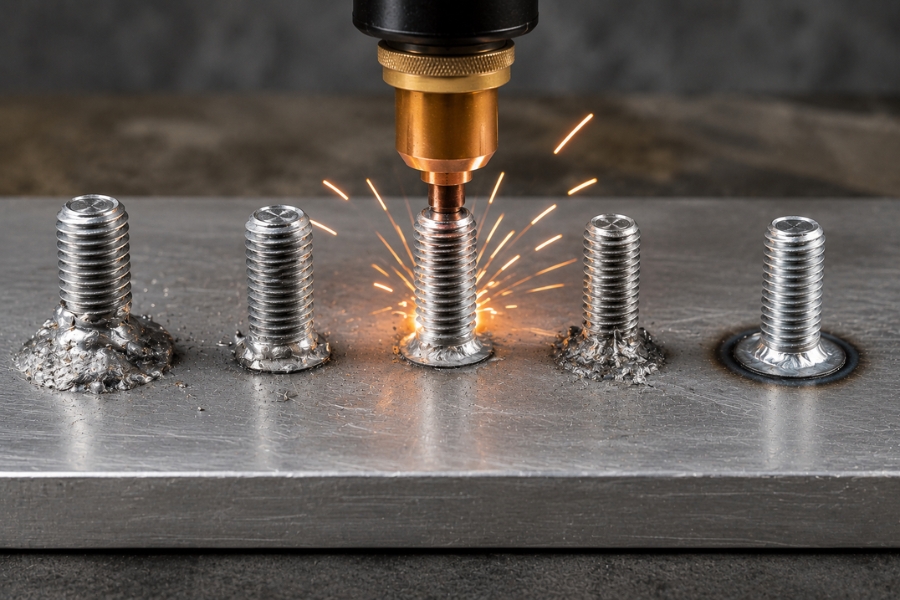
Understanding what goes wrong helps you prevent it. Here are the most frequent errors welding teams make when stud welding aluminum:
Skipping oxide removal
Aluminum oxide forms within seconds. Even a freshly cut aluminum surface begins oxidizing immediately. Welders who skip brushing with a stainless steel brush and wiping with a non-VOC cleaner trap that oxide layer in the weld. The result is a porous, under-strength connection that fails under load.
Using the wrong polarity
Steel welding uses direct current electrode negative (DCEN). Aluminum welding requires direct current electrode positive (DCEP). Using the wrong polarity on aluminum produces an unstable arc and poor fusion. This is one of the most overlooked settings errors in the field.
Welding too slowly
Slow weld cycles allow aluminum’s thermal conductivity to pull heat away before full fusion occurs. Both CD and drawn arc processes on aluminum require the fastest possible cycle times. CD welding on aluminum typically completes in 10 milliseconds or less. Similarly, drawn arc parameters on aluminum must prioritize speed over typical steel settings.
Omitting shielding gas on drawn arc applications
Steel drawn arc welding uses ceramic ferrules alone to contain the weld pool. Aluminum drawn arc welding requires shielding gas typically 100% argon in addition to the ferrule. Without it, the weld zone oxidizes during the arc phase and the fusion is compromised.
Using steel-spec studs on aluminum
Standard steel arc studs are not designed for aluminum base materials. Aluminum applications require studs with a built-in ignition tip that burns away cleanly before the arc forms. This extends the arc duration and generates the additional heat aluminum needs for proper fusion.
CD vs. Drawn Arc: Which Works Better on Aluminum?
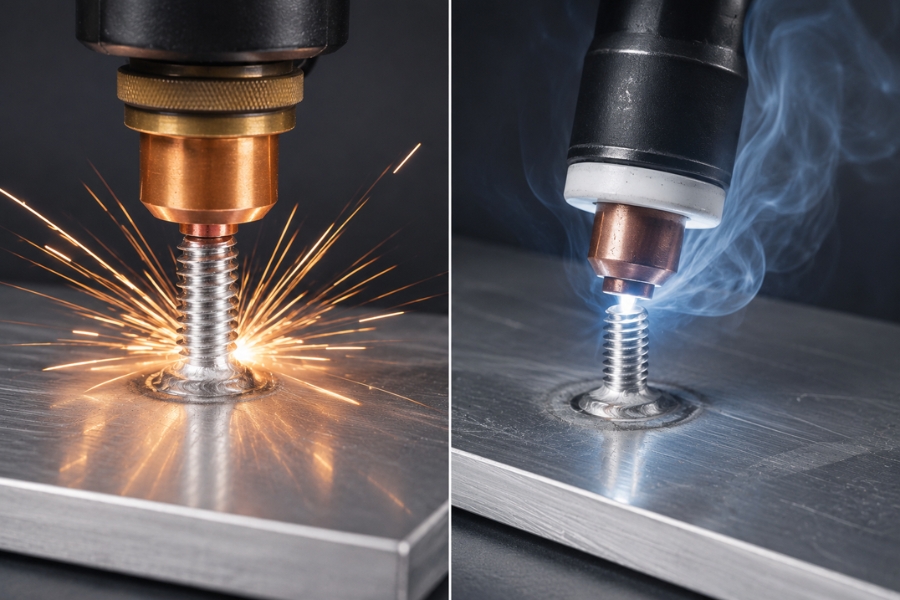
Both processes work on aluminum, but they suit different applications.
Capacitor discharge (CD) welding works best on thin aluminum sheet material. The extremely short weld cycle, often under 10 milliseconds, limits heat input. This prevents burn-through and keeps the reverse side of the material clean and unmarked. CD studs on aluminum are widely used in sheet metal fabrication, electrical enclosure manufacturing, and food service equipment production where surface appearance matters.
Drawn arc welding handles thicker aluminum sections and larger stud diameters where CD cannot generate enough energy. However, it requires shielding gas, correct ferrule selection, and precise parameter calibration. In addition, the stud itself must be specifically designed for aluminum, not a steel stud used on an aluminum surface.
Choosing the right process starts with knowing your base material thickness and the stud diameter your application requires. If you carry both arc studs and CD studs in your inventory, confirm that each is matched to its correct process before starting a run on aluminum.
How to Check Your Weld Quality on Aluminum
After each weld, examine the flash ring around the base of the stud. On a good aluminum weld, the flash ring appears consistent and dull. A shiny stud base or shiny surface around the weld indicates insufficient heat. The material reached the melting threshold but did not fuse completely.
Bend testing remains the most reliable field method. Apply a lateral force to the stud and look for the base to stay clean on the parent material. A poor weld breaks at the interface. A correct weld bends the stud shank before the weld itself fails.
Also check your stud welding accessories specifically ferrules and chucks for aluminum applications. A ferrule worn from steel use or sized incorrectly for your stud diameter produces an incomplete weld profile regardless of how well you set the machine parameters.
Source the Right Aluminum Stud Welding Supplies from Northland Fastening Systems
Getting stud welding aluminum right depends as much on your materials as your process. Northland Fastening Systems supplies CD studs, arc studs, and stud welding accessories specifically suited for aluminum applications in the diameters, lengths, and materials your project specification requires.
Our team works directly with welding engineers, purchasing managers, and fabrication supervisors to match the right product to the right application. We also offer equipment rentals for teams scaling up aluminum welding programs without committing to a capital purchase.
Call us at 651-730-7770 to speak with a product specialist today. We are ready to help you order the right supplies and avoid the mistakes that cost your team time and money.
Frequently Asked Questions
Q1. Why does stud welding aluminum require different settings than steel?
Aluminum conducts heat four times faster than steel. It also forms an oxide layer instantly. Both factors require faster weld cycles, correct polarity, and shielding gas for drawn arc applications.
Q2. What polarity setting does aluminum stud welding require?
Aluminum stud welding requires direct current electrode positive (DCEP). Using electrode negative (DCEN) produces an unstable arc and poor weld fusion on aluminum base materials.
Q3. Can standard steel studs be used for stud welding aluminum?
No. Aluminum applications require studs with a built-in ignition tip designed for aluminum. Standard steel studs do not generate sufficient arc duration for proper fusion on aluminum surfaces.
Q4. How do I know if my aluminum stud weld failed?
A shiny weld base or inconsistent flash ring indicates poor fusion. Bend testing is the most reliable field method when a failed weld breaks cleanly at the interface under lateral force.