Investing in an automatic stud welding machine is one of the most significant equipment decisions a fabrication operation makes. The right machine improves output consistency, reduces labor dependency, and cuts per-unit weld costs dramatically on high-volume programs. However, choosing the wrong model — or choosing to buy when renting makes more sense — creates capital tied up in underutilized equipment and operational problems your team did not anticipate. Therefore, this guide covers everything you need to evaluate before committing to a purchase or rental so your operation gets the right machine for the right application from day one.
What an Automatic Stud Welding Machine Actually Does
An automatic stud welding machine performs drawn arc or capacitor discharge stud welding with programmable controls, consistent arc generation, and repeatable positioning — all with minimal operator intervention. Unlike manual stud welding guns, automatic systems feed studs, position them, fire the weld, and move to the next point in a continuous cycle.
In addition, modern systems integrate with robotic arms, CNC positioning tables, and conveyor-fed production lines. As a result, they deliver weld-to-weld consistency that a manual operation cannot replicate at the same speed. Furthermore, they reduce operator fatigue, lower the skill threshold required for each weld point, and produce documented weld data that supports quality control and inspection processes.
As production volumes increase, the productivity difference between manual and automatic welding is significant. The question is not whether automation helps — it is whether buying or renting makes the most operational and financial sense for your specific program.
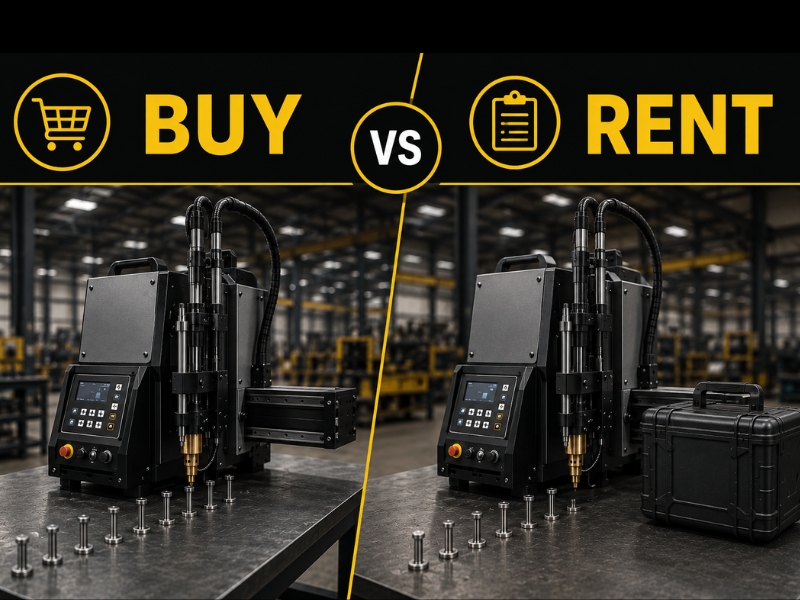
Buy vs. Rent: How to Make the Right Decision
The decision between purchasing and renting an automatic stud welding machine depends on four key factors: program duration, production volume, machine utilization rate, and capital availability. Use the table below to evaluate which approach fits your operation.
| Factor | Buy | Rent |
|---|---|---|
| Program duration | Long-term or ongoing production | Short-term or project-specific work |
| Weekly utilization | High – machine runs most shifts | Low to moderate – periodic use only |
| Capital availability | Capital budget available for equipment | Capital better allocated to materials or labor |
| Production volume | High and consistent across months | Variable or project-dependent |
| Maintenance responsibility | In-house or service contract needed | Supplier handles maintenance |
| Equipment updates | Fixed to purchased model | Access to updated models each rental |
| Break-even timeline | Typically 12–24 months at full utilization | No break-even required – cost per project |
| Flexibility | Low – committed to one machine | High – scale up or down per program |
In practice, fabrication shops with consistent high-volume production benefit most from purchasing. By comparison, construction contractors, project-based manufacturers, and operations scaling up for a single large program benefit more from renting. Ultimately, the right answer depends on your volume pattern — not just your budget.
Key Specifications to Evaluate Before You Commit
Whether you buy or rent, the machine specification must match your application. Here is what to check before any commitment:
Stud diameter range — Automatic systems handle specific diameter ranges. Confirm the machine covers the full range your program requires, from small CD studs on thin panels to large drawn arc studs on structural steel.
Process type — Drawn arc systems suit structural steel, composite construction, and heavy applications. CD systems suit thin sheet metal, enclosure manufacturing, and applications where reverse-side marking must be avoided. Some operations require both processes — confirm the machine handles your specific process before ordering.
Weld cycle speed — Automatic systems vary from 10 to 30+ welds per minute depending on model and configuration. Match the cycle speed to your production schedule requirements, not the fastest available spec.
Base material compatibility — Confirm the machine handles your base material — mild steel, stainless steel, or aluminum — with the correct settings and accessories. Aluminum applications require controlled energy delivery that not all automatic systems provide equally well.
Positioning system — Some systems use fixed positioning fixtures. Others use CNC tables or robotic arms for flexible multi-point programs. Match the positioning system to your part geometry and weld pattern requirements.
Power requirements — Automatic systems draw significant power. Confirm your facility’s electrical capacity supports the machine’s input requirements before installation.
Related read : Drawn Arc Stud Welding: How It Works, Materials, and Applications
How Automation Changes the Operator’s Role
Many fabrication managers hesitate to invest in automation because they assume it displaces skilled operators. In practice, the role shifts rather than disappears. Skilled operators move from performing each weld manually to programming, monitoring, and maintaining the automatic system.
As a result, one operator can oversee multiple automatic systems simultaneously — a workflow that manual stud welding cannot support. Moreover, the consistency of an automatic system reduces the quality dependence on individual operator skill, which matters when experienced welders are unavailable or turnover is high.
Therefore, for operations considering automation for the first time, renting an automatic system for one program before purchasing gives your team hands-on experience with the workflow change. This reduces the risk of a poor buying decision and identifies any production adjustments needed before committing capital.
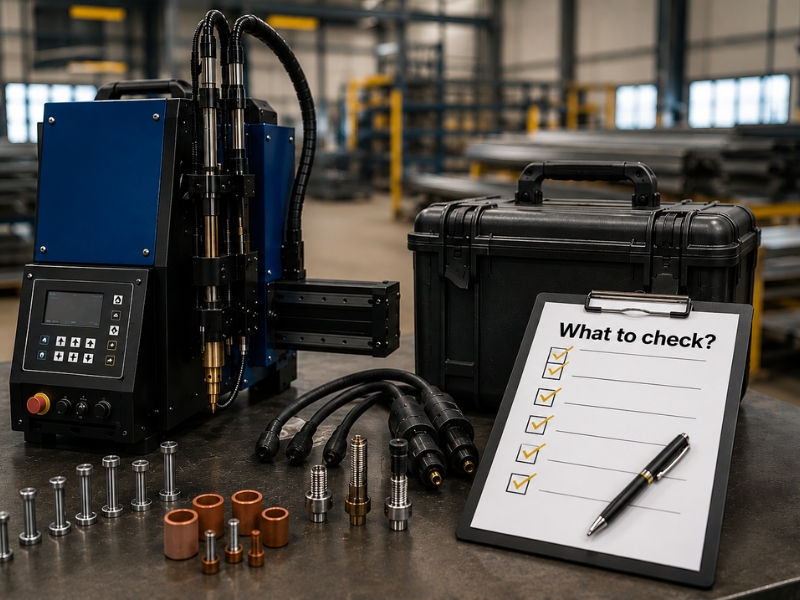
What to Check When Renting an Automatic Stud Welding Machine
Renting delivers flexibility, but not all rental programs are equal. Before you commit to a rental from Northland Fastening Systems or any supplier, confirm the following:
Machine condition and calibration — A rental machine must arrive calibrated and ready to run. Ask your supplier to confirm the machine has been serviced and tested before delivery. A machine that requires on-site calibration adds setup time your schedule cannot absorb.
Accessory compatibility — Confirm the rental machine uses the same chucks, ferrules, and cables your team already stocks. Using unfamiliar accessories on an unfamiliar automatic system adds complexity and increases the risk of setup errors.
Technical support availability — Ask whether your rental supplier provides technical support by phone during your rental period. If an automatic system stops mid-production, you need a supplier who can diagnose the issue quickly and ship a replacement part or machine the same day.
Rental duration flexibility — Programs run long. Confirm your rental agreement allows extension without penalty if your project timeline changes.
The best rental programs come from suppliers who stock their own equipment, understand the machines they rent, and carry the CD studs, arc studs, ferrules, and accessories to support your full production run from the same source.
Source Automatic Stud Welding Equipment from Northland Fastening Systems
We supply automatic stud welding equipment for both purchase and rental, along with a complete range of studs, ferrules, chucks, and accessories to support your operation. Our team helps fabrication shops, construction contractors, and production managers choose the right equipment for their specific applications. You can also stay connected with us through our Google Business Profile and Facebook for updates, product information, and industry insights.
Whether you are investing in your first automatic stud welding machine or expanding an existing production line, we provide the technical guidance and equipment support needed to make the right choice. Call 651-730-7770 to speak with an equipment specialist, discuss your application, and request a quote for the best solution for your project.
Frequently Asked Questions
Q1: What is the main difference between a manual and an automatic stud welding machine?
A manual stud welding gun requires an operator to position and fire each weld individually. An automatic stud welding machine feeds, positions, and fires welds in a continuous programmed cycle with minimal operator intervention per weld point.
Q2: How do I know if my production volume justifies buying an automatic stud welding machine?
If your operation runs more than several hundred studs per shift consistently across multiple months, purchasing typically reaches break-even within 12 to 24 months. Lower or variable volume programs are better served by renting per project.
Q3: Can an automatic stud welding machine handle both drawn arc and CD welding processes?
Some multi-process systems handle both, but most automatic machines are designed for one process. Confirm the process type before renting or purchasing and match it to your specific application requirements.
Q4: What support should a rental supplier provide for an automatic stud welding machine?
A reliable rental supplier delivers a calibrated, tested machine, provides compatible accessories, offers technical support by phone during the rental period, and carries replacement parts or backup machines for urgent situations.