Welding on bridges is not the same as welding on a factory floor or a fabrication bench. Every joint on a bridge must handle decades of dynamic loading, continuous vibration, temperature swings of 100°F or more, and the constant stress of live traffic. Because of these demands, bridge engineers and structural steel fabricators rely on a specific set of welding products and techniques. As a result, stud welding sits at the center of nearly every major bridge construction and rehabilitation project in the country. This guide explains why, what products are involved, and what to look for when you source materials for a bridge project.
Why Stud Welding Plays a Central Role in Bridge Construction
Bridge structures combine two very different materials, structural steel and reinforced concrete into a single load-bearing system. Therefore, getting those two materials to act together structurally is the critical challenge that stud welding solves.
When engineers design a composite bridge deck, they specify shear connectors welded to the top flanges of steel beams. After the concrete deck pours and cures around these connectors, the steel and concrete lock together and function as one composite unit. This dramatically increases the load capacity of the beam system compared to what either material could carry independently.
Without welding on bridges using properly specified shear connectors, the concrete deck and the steel beams simply sit on top of each other. They deflect independently, which reduces structural efficiency and accelerates fatigue damage under traffic loading. The shear connector is what transforms two separate materials into one strong system.
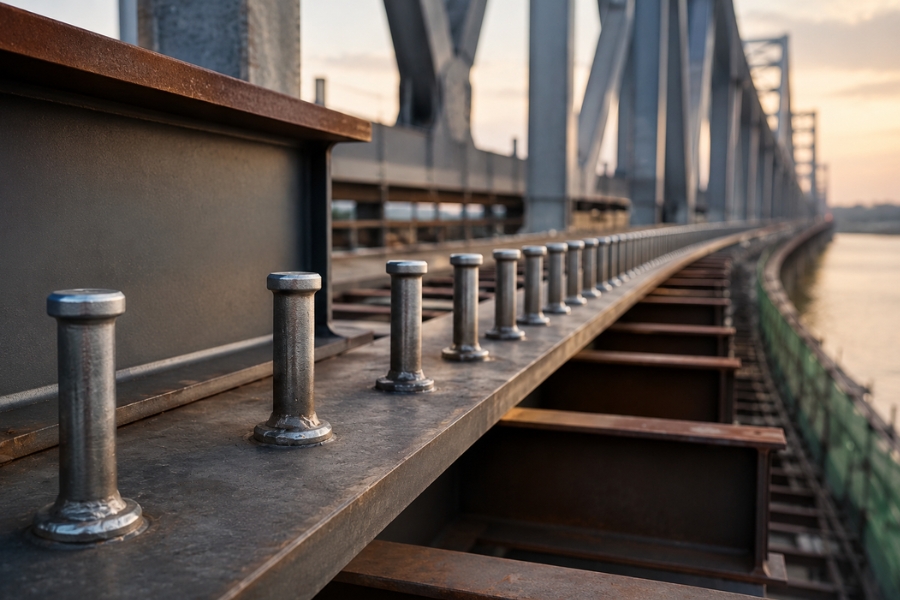
Shear Connectors: The Most Critical Stud in Bridge Work
Shear connectors are large-diameter arc studs typically 3/4″ or 7/8″ in diameter that engineers specify for composite deck applications. Fabricators weld them to beam top flanges using arc studs and the drawn arc stud welding process before the concrete pour takes place.
The drawn arc process suits this application for several key reasons. It produces a full cross-sectional weld that passes AWS D1.1 structural certification requirements. In addition, it works quickly across a high volume of welds per beam, which matters on large bridge deck fabrication programs. And it creates a bond stronger than the stud material itself, a critical property when the connector must resist horizontal shear forces over the full design life of the structure.
AWS D1.5, the Bridge Welding Code, governs the specification and testing requirements for shear connectors in bridge applications. Every shear connector used on a code-governed bridge project must meet these requirements exactly. This makes material sourcing a quality decision, not just a price decision.
Other Applications of Welding on Bridges
Shear connectors are the most prominent stud welding application in bridge work, but they are not the only one. Construction teams also use stud welding in several other bridge-specific contexts.
For example, anti-skid studs weld directly to bridge deck plates and approach surfaces to create the rumble effect that alerts drivers they are entering or exiting a bridge zone. These studs must stay firmly bonded through years of freeze-thaw cycles and heavy vehicle contact.
Similarly, embed plates and headed anchors connect steel structural members to concrete substructure elements piers, abutments, and bearing seats. Headed anchors provide the pullout resistance that holds these connections together under uplift and seismic loads.
Plate connection points use stud welding to tie steel girder sections and plating to concrete components, creating durable, flexible connections that accommodate the thermal expansion and contraction that every bridge experiences through seasonal temperature changes.
Each of these applications requires a different stud type, diameter, and specification. Getting the selection right at the ordering stage prevents rework and inspection failures that cost far more than the studs themselves.
What Makes a Quality Stud Welding Supplier for Bridge Projects
Bridge projects carry tight inspection requirements and strict material traceability standards. For this reason, the supplier you choose directly affects whether your materials pass certification review or create delays.
A reliable stud welding supplier for bridge work like Northland Fastening Systems stocks products that meet AWS D1.1 and AWS D1.5 specifications with full material certifications available on request. They carry the full range of shear connector and headed anchor diameters and lengths your project specification calls for. Furthermore, they ship accurately and on schedule, because a delayed stud order on an active bridge deck pour schedule is a serious problem.
When you work with our team, you get access to a complete inventory of shear connectors, headed anchors, and arc stud accessories all meeting applicable AWS standards. Our team reviews project specifications with you directly so that you order the right product the first time, not the wrong one that passes a visual check but fails material certification.
Northland Fastening Systems Supplies for Bridge Projects
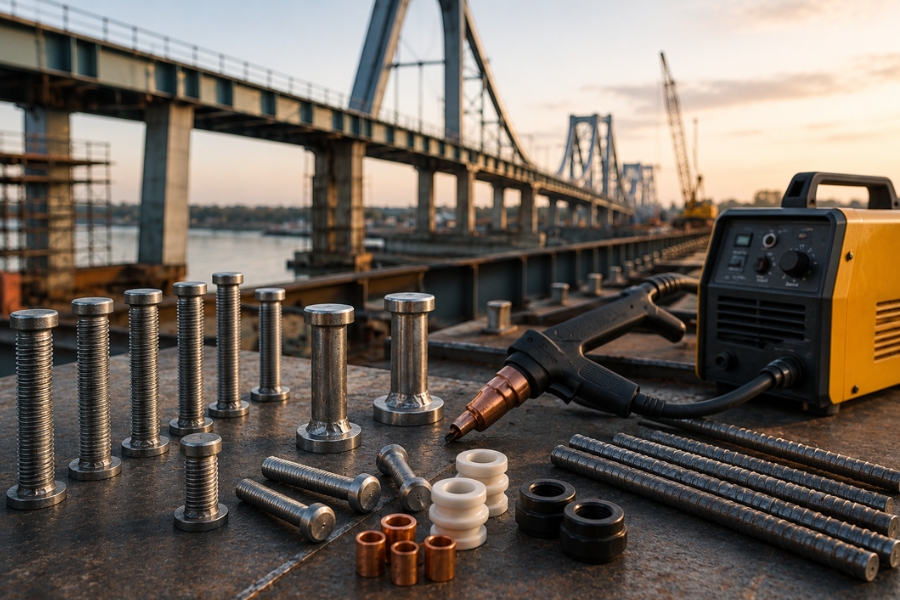
Northland Fastening Systems stocks the full range of stud welding products that bridge construction and structural steel fabrication teams need, including:
- Shear connectors in 3/4″ and 7/8″ diameters
- Headed anchors in standard and custom lengths
- Deformed bar anchors for specialty embed applications
- Ceramic ferrules and weld-through deck accessories
- Arc stud welding equipment for rent or purchase
Call us at 651-730-7770 to discuss your bridge project requirements. As a result, our team matches the right products to your specification and makes sure your order ships complete and on time.
You can also stay connected with us through our Google Business Profile and Facebook page for project updates, product availability, industry insights, and the latest stud welding solutions for bridge construction projects.
Frequently Asked Questions
Q1. Why are shear connectors important in bridge construction?
Shear connectors help steel beams and concrete decks work together as one structure, improving load distribution, durability, and long-term bridge performance under traffic stress.
Q2. How does stud welding improve bridge structural safety?
Stud welding creates strong, permanent bonds between structural components, helping bridges resist vibration, fatigue, heavy traffic loads, and changing environmental conditions over time.
Q3. What standards apply to welding on bridge projects?
Bridge welding projects typically follow AWS D1.1 and AWS D1.5 standards to ensure weld quality, structural integrity, material compliance, and long-term performance reliability.
Q4. Which stud types are commonly used on bridges?
Bridge projects commonly use shear connectors, headed anchors, and deformed bar anchors for composite decking, embed applications, and structural steel-to-concrete connections.