Every drawn arc stud welding operation depends on more than a power source and a gun. The arc welding accessories your team uses determine whether each weld passes inspection, holds its rated load, and performs consistently across an entire production run. Many operations invest in quality studs and reliable machines but underestimate how quickly worn or mismatched accessories introduce weld failures that are difficult to diagnose and costly to correct. This guide identifies every accessory a drawn arc setup requires, explains what each one does, and shows how each one directly affects the quality of every weld your team produces.
Why Arc Welding Accessories Determine Weld Outcome
Accessories sit between your machine and your weld. Every energy input, every arc alignment decision, and every weld pool containment action runs through the accessories your team selects and maintains. Therefore, accessory condition and compatibility directly affect the arc stability, stud positioning, and flash ring quality that inspectors evaluate on every structural weld.
A mismatched chuck allows the stud to shift during the arc phase. As a result, the plunge point lands off-center and creates an asymmetric weld cross-section that fails tensile load requirements. A corroded cable connector increases circuit resistance, which reduces arc energy at the weld zone and produces an undersized flash ring that fails AWS visual inspection criteria. A ferrule that does not match the stud diameter fails to contain the weld pool properly, leaving irregular spatter and an incomplete fusion zone.
Furthermore, worn accessories create diagnostic confusion. Operators adjust machine settings to compensate, which introduces new variables and makes the root cause harder to identify. Replacing worn arc welding accessories before they cause problems is always faster and cheaper than tracing weld failures back to accessory issues after a failed inspection.
Complete Arc Welding Accessories Reference: What You Need and Why
The table below covers every primary accessory in a standard drawn arc setup, its function in the weld cycle, and the failure it prevents when selected and maintained correctly.
| Accessory | Function in Weld Cycle | Failure It Prevents |
|---|---|---|
| Ceramic Ferrule | Contains the weld pool, shapes the flash ring, and shields the arc zone. | Incomplete fusion, irregular flash rings, and spatter contamination. |
| Adjustable Chuck | Grips the stud shank and keeps it correctly positioned during lift and arc. | Off-center plunge and asymmetric weld cross-sections. |
| Collet Insert | Centers the stud within the chuck for precise positioning. | Lateral stud movement and inconsistent flash ring geometry. |
| Ferrule Grip / Foot | Positions the ferrule flush against the base material. | Ferrule tipping and uneven weld pool containment. |
| Cable Connector | Transfers welding current from the cable to the welding gun. | Resistance increase, arc energy loss, and undersized flash rings. |
| Cable Lug | Secures the ground cable to the base material. | Arc instability caused by poor ground connections. |
| Spark Shield | Protects the operator and nearby surfaces from weld spatter. | Surface damage and operator exposure during the welding process. |
| Ferrule Foot Plate | Supports the ferrule on flat applications requiring additional stability. | Ferrule movement during the weld cycle. |
| Tube Adapter | Adapts the welding gun body to different stud shank profiles. | Chuck engagement failure on non-standard stud geometries. |
| B-Stop | Controls the stud protrusion depth inside the welding gun. | Incorrect plunge distance and insufficient weld pool depth. |
Every accessory in this table plays a direct role in weld quality. Treat any of them as optional and your weld consistency will reflect it.
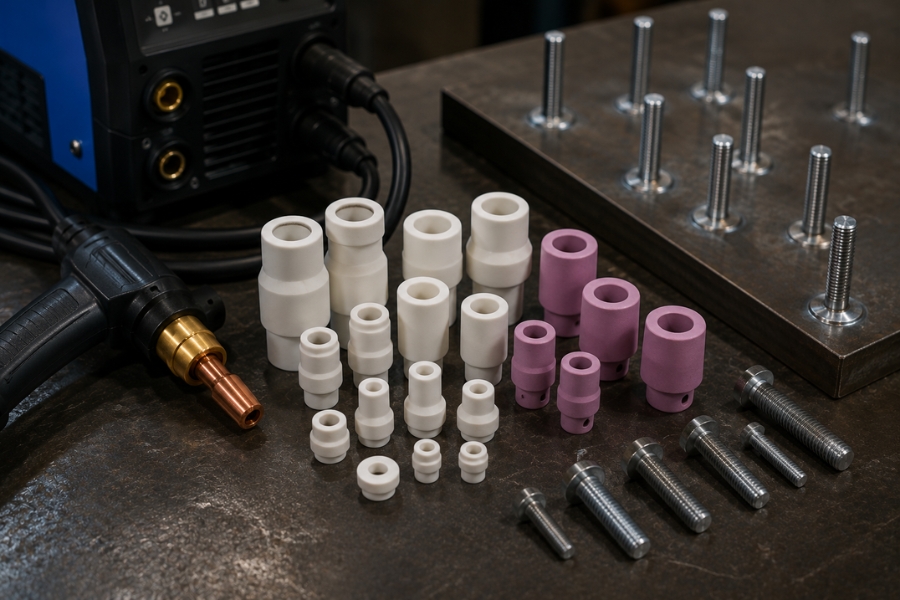
Ceramic Ferrules: The Single Most Impactful Accessory in the Setup
Of all arc welding accessories, the ceramic ferrule carries the most direct influence on what your inspector sees after each weld. It contains the molten metal pool during the arc phase, concentrates heat at the fusion zone, and shapes the flash ring that serves as the visual indicator of weld quality for arc studs.
Ferrule selection requires matching three variables: stud diameter, application type, and base material geometry. Standard flat ferrules suit most down-hand structural applications. Thru-deck ferrules suit composite construction applications where studs weld through steel decking before the concrete pour. Reduced-base ferrules fit studs with unthreaded lower sections. Collar ferrules suit low-profile stud applications in tight clearance conditions.
Using the wrong ferrule type on any of these applications produces an irregular flash ring, traps spatter inside the weld zone, and creates a connection that fails AWS D1.1 visual inspection criteria regardless of how well the machine is set. Therefore, always verify ferrule type and diameter against the stud specification before starting any production run — not after the first failed inspection.
Chucks and Collets: Positioning Accuracy Across Every Weld
The chuck grips each stud during the lift and arc phase of the drawn arc process. The collet insert centers the stud within the chuck to ensure identical positioning on every cycle. Together, they control the most critical variable in weld consistency: where the stud contacts the molten pool during plunge.
As chucks wear from repeated use, the grip becomes inconsistent. Slight lateral movement during the arc phase shifts the plunge point off-center. Over time, this produces welds with asymmetric flash rings and reduced cross-sectional bond area — a critical issue on structural programs where weld strength is certified and inspected against AWS standards.
Replace chucks at the first sign of visible wear on the gripping surfaces, or when operators begin noticing inconsistent flash ring profiles across a run. Similarly, inspecting collet inserts at regular service intervals and replacing them before wear causes positioning errors that require machine recalibration to diagnose.
Cable Connectors and Ground Connections: The Foundation of Arc Stability
The welding circuit carries high-amperage current from the power supply to the gun and through the weld zone. Every mechanical connection point in that circuit, including critical arc accessories such as cable connectors and ground lugs, must maintain low resistance for the arc energy to arrive at the stud correctly.
Corroded or loose cable connectors reduce the arc energy that reaches the weld zone. Operators typically compensate by increasing machine power settings. However, this produces excessive heat input and oversized flash rings rather than addressing the actual connection problem. Consequently, cable connectors must be inspected at the start of every shift and replaced immediately at the first sign of corrosion, heat damage, or mechanical looseness.
Ground cable lugs require the same discipline. A loose or corroded ground lug creates arc instability that manifests as inconsistent flash rings and variable weld penetration across a run. Keep all ground contact surfaces clean, confirm mechanical connection is secure, and replace lugs before corrosion builds to a level that affects arc behavior.
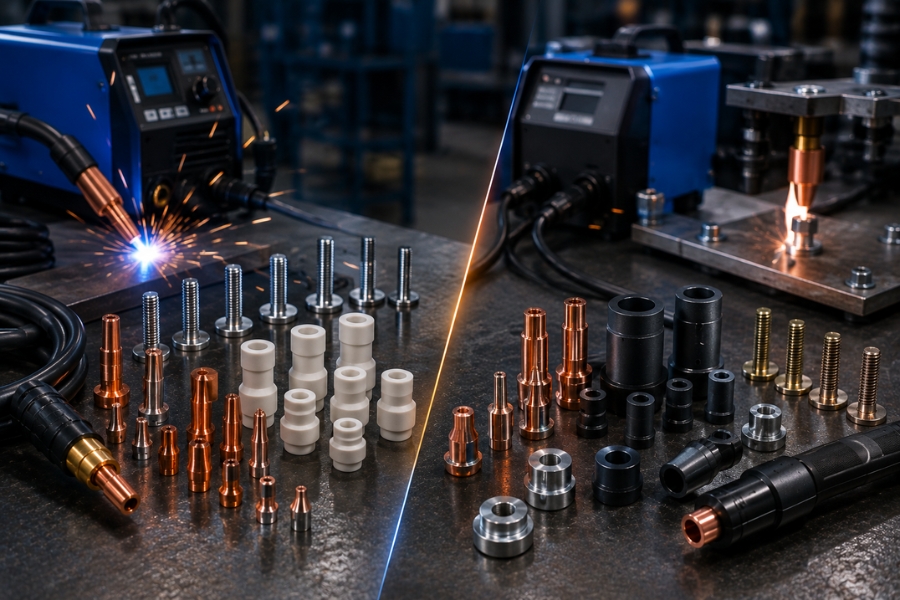
Matching Accessories to Stud Type: Drawn Arc vs. CD Applications
It is worth clarifying that arc welding accessories are specific to the drawn arc process. They are not interchangeable with capacitor discharge accessories. A ferrule designed for a drawn arc stud does not seat correctly on a CD weld pins application, and a CD chuck does not grip drawn arc stud shanks at the correct diameter or depth.
Teams running both processes must maintain separate accessory sets for each. Mixing accessories across processes introduces fit errors that mimic machine calibration problems and waste significant diagnostic time. Label accessory sets clearly by process and stud diameter range, and store them separately to prevent job setup errors.
For drawn arc applications specifically, arc studs and their matching ferrules, chucks, and cable accessories must all come from the same specification source. A stud ordered from one supplier paired with accessories from another creates compatibility risk that only becomes visible after the first failed inspection.
Source Arc Welding Accessories from Northland Fastening Systems
We stock a complete range of drawn arc welding accessories, including ceramic ferrules, adjustable chucks, ferrule grips, ferrule foot plates, cable connectors, cable lugs, spark shields, collet inserts, tube adapters, and B-stops for structural and industrial applications. Our team verifies compatibility with your stud type and equipment before every order. Visit our Google Business Profile and Facebook to stay updated on our products and industry expertise.
Whether you need replacement accessories or a complete setup for a new project, we provide dependable product guidance to help keep your welding operation running efficiently. Call 651-730-7770 to speak with a product specialist, confirm the right accessories for your equipment, and request a quote for your project.
Frequently Asked Questions
Q1: How often should ceramic ferrules be replaced in a drawn arc setup?
Ceramic ferrules are single-use components. Replace them after every weld. Reusing a ferrule causes incomplete weld pool containment, irregular flash ring formation, and weld profiles that fail AWS visual inspection on structural applications.
Q2: What causes arc instability in a drawn arc stud welding setup?
Arc instability most commonly results from corroded cable connectors, loose ground cable lugs, or worn collet inserts that allow stud movement during the arc phase. Inspect all three at the start of every shift before adjusting machine power settings.
Q3: Can I use the same chuck for different stud diameters in a drawn arc setup?
No. Each chuck must match the stud shank diameter it grips. Using a chuck designed for a different diameter causes inconsistent stud positioning during the arc phase and produces asymmetric welds that fail tensile and visual inspection requirements.
Q4: Where can I source a complete set of drawn arc welding accessories?
Northland Fastening Systems stocks the full range of drawn arc accessories in all standard types, diameters, and AWS-compliant specifications. Contact us or visit norfas.com to confirm compatibility and place your order.