Shipbuilding is one of the most demanding environments any fastening system will ever face. Every connection inside a commercial vessel, naval ship, or offshore platform must withstand constant stress. Vibration, salt air corrosion, and extreme temperature swings all take their toll over decades. Stud welding in shipbuilding has earned its place as the fastening method of choice across these environments. This is not by accident — it consistently delivers speed, strength, and reliability that traditional mechanical fasteners simply cannot match at scale. Northland Fastening Systems supplies the stud welding products that shipbuilding teams and marine fabricators depend on to get this work done right.
Why Shipbuilders Choose Stud Welding Over Traditional Fasteners
Traditional fastening methods — bolts, rivets, and mechanical clips — all require access to both sides of a surface. In a commercial ship or naval vessel, that kind of access is often impossible. Hull panels, bulkheads, deck plates, and structural frames create tight, confined spaces where reverse-side access simply does not exist.
Stud welding solves this problem directly. It requires access to only one side of the base material. A technician positions the stud, fires the weld, and moves to the next point in under a second. Northland Fastening Systems supplies the equipment and studs that support these demanding applications. Furthermore, the resulting bond is stronger than the stud material itself — meaning the weld will never be the weak point in the connection.
This combination of single-sided access and exceptional bond strength makes stud welding the most practical fastening method for shipbuilding. As a result, it remains the most reliable choice across vessel types and sizes.
Key Applications of Stud Welding in Shipbuilding
Stud welding serves multiple distinct functions across a marine construction project. Understanding each application helps shipbuilding teams select the right product for each specific use.
Insulation Fastening
Thermal and acoustic insulation is critical on every commercial vessel. Insulation panels must attach securely to interior hull surfaces, bulkheads, and overhead structures throughout the ship. CD weld pins are the standard fastening solution for this application. These small-diameter capacitor discharge pins weld cleanly to the steel surface in milliseconds, leaving no burn-through or reverse-side marking. The insulation panel slides over the pin and locks in place with a speed clip.
CD weld pins suit this application because they generate minimal heat input. This is critical when working near sensitive materials or in tight interior spaces, where heat spread could otherwise damage adjacent surfaces or coatings.
Cable Management
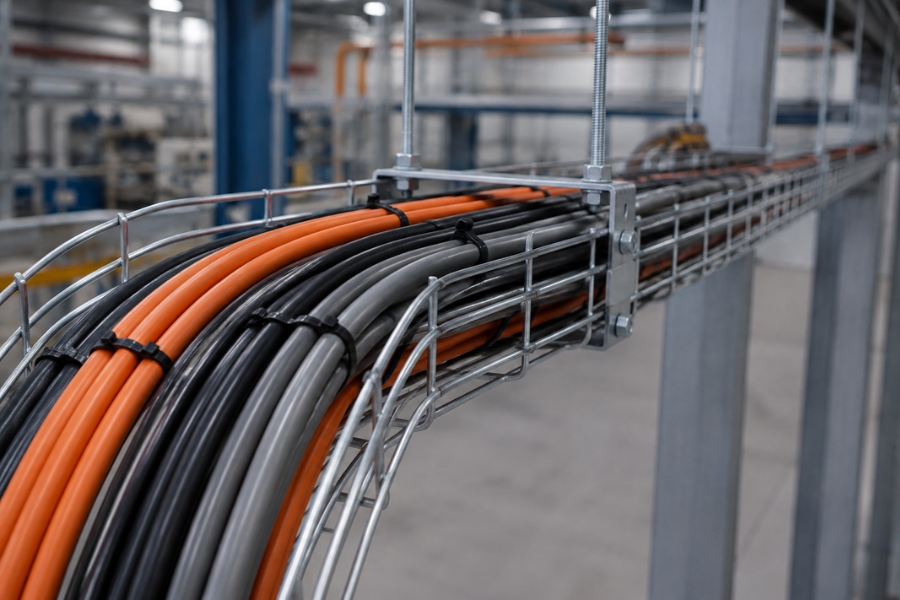
Every ship carries thousands of meters of electrical cable, hydraulic lines, and communications wiring. These systems run through the vessel from bow to stern. Organizing, securing, and routing these systems requires a consistent, reliable fastening solution. This solution must be installed across hundreds or thousands of points throughout the hull.
Stud weld cable hangers and pipe anchors attach directly to structural steel surfaces using the drawn arc or CD process. As a result, the cable management system stays locked in position through decades of vibration, mechanical stress, and thermal cycling. It resists loosening and corrosion, and unlike mechanical anchors, it never requires periodic retightening.
Structural Connections
Large commercial vessels and naval ships use structural stud welding for load-bearing connections throughout the hull and superstructure. Headed anchors and arc studs attach structural steel components, bracket assemblies, and equipment mounting frames to the ship’s primary structure. These connections must carry significant static and dynamic loads — and they must maintain their integrity through the working life of the vessel without maintenance access.
Drawn arc stud welding suits these structural applications because it produces a full cross-sectional weld that meets AWS structural certification requirements. Furthermore, the process completes each weld in under one second, which makes it practical on large vessel construction programs where hundreds of structural connection points must be completed efficiently.
Deck Fittings and Surface Attachments
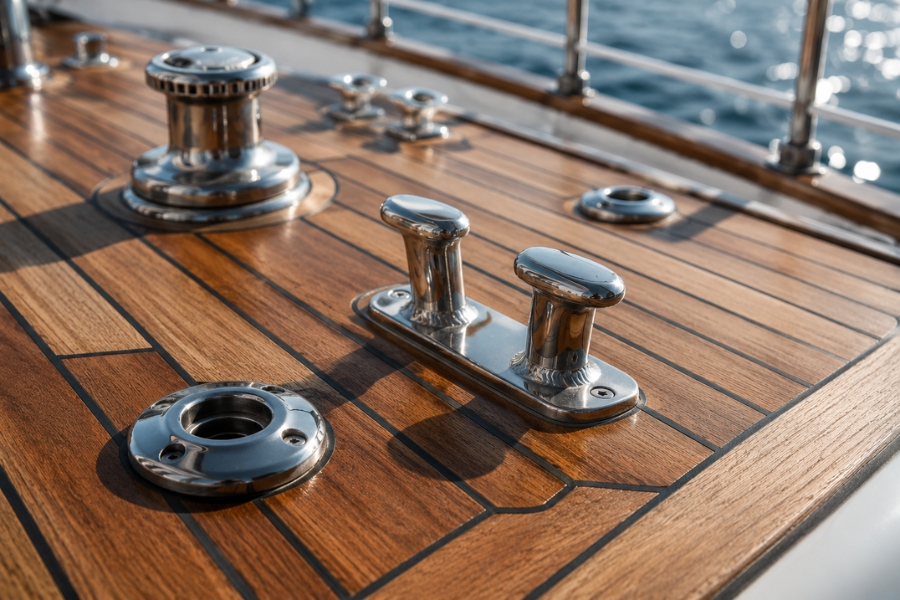
Anti-skid studs, equipment pads, pipe supports, and deckplate attachments all rely on stud welding for fast, permanent installation on marine decks and working surfaces. These fittings face direct exposure to sea water, mechanical wear, and thermal expansion across temperature ranges that mechanical fasteners handle poorly over time.
Stud welded deck fittings eliminate the need for through-hole drilling, which preserves the structural integrity of deck plating and removes the corrosion risk that drilled and bolted connections create at every hole edge.
Choosing the Right Stud Welding Products for Marine Applications
Not all stud welding products perform equally in marine environments. Shipbuilding teams need to consider three factors when selecting products for any vessel application.
Material grade — Standard mild steel studs suit interior structural applications where coating protects the connection. Stainless steel studs are required for any application with direct exposure to salt water, marine atmosphere, or food-grade environments on passenger vessels. Confirm material grade against the application environment before ordering.
Process type — Drawn arc welding suits structural connections, large-diameter studs, and applications requiring maximum bond strength. Capacitor discharge welding suits insulation pins, cable hangers, thin panel attachments, and any application where heat input must be minimized. Our team carries both process types in the full range of diameters and lengths marine applications require.
AWS compliance — Naval and commercial vessel construction programs operate under strict material and inspection standards. All stud welding products used on certified marine projects must meet AWS D1.1 specifications, with full material certification documentation available on request. Confirm certification availability before placing any structural order.
What Northland Fastening Systems Supplies for Shipbuilding Teams
Northland Fastening Systems stocks the complete range of stud welding products that marine fabricators and shipbuilding operations need — including headed anchors, threaded arc studs, CD weld pins for insulation fastening, cable hanger studs, and stainless steel grades for corrosion-sensitive applications. All products meet AWS specifications and come with full material certification documentation available on every structural order.
In addition to consumables, we supply arc studs in the full range of diameters and lengths required for structural marine applications, as well as stud welding equipment for both purchase and rental. Equipment rentals give shipbuilding teams the flexibility to scale up for large vessel programs without committing to a capital equipment purchase for project-specific work.
Call us at 651-730-7770 to speak with a product specialist about your marine project requirements. We confirm specifications, match products to your application, and make sure your order ships complete and on time.
Frequently Asked Questions
Q1: Why is stud welding preferred over bolting in shipbuilding applications?
Stud welding requires access to only one side of the surface, which suits the confined and complex geometry of ship interiors. It also produces a stronger bond than bolting and eliminates the corrosion risk that drilled holes introduce at every mechanical fastener point.
Q2: What stud welding products are used for insulation fastening on ships?
CD weld pins are the standard product for insulation fastening on marine vessels. They weld cleanly to steel surfaces with minimal heat input, leave no reverse-side marking, and accept standard speed clips to lock insulation panels securely in position.
Q3: Do marine stud welding applications require AWS-certified materials?
Yes. Commercial and naval vessel construction programs require stud welding materials that meet AWS D1.1 specifications. Material certification documentation must be available on request for any structural or certified application on a marine project.
Q4: Can stud welding equipment be rented for a shipbuilding project?
Yes. Northland Fastening Systems offers stud welding equipment for both purchase and rental, making it practical for shipbuilding teams to access the right equipment for a specific vessel program without a long-term capital commitment.