When project teams evaluate fastening options for structural or industrial applications, drawn arc stud welding consistently stands out, not just for weld strength, but for overall cost efficiency across the full project lifecycle. Bolting, riveting, and conventional welding each carry hidden costs that fabrication teams often overlook at the planning stage. This guide breaks down how drawn arc stud welding compares against these traditional methods and explains where it delivers the clearest financial and operational advantages.
The Real Cost of Traditional Fastening Methods
Many fabrication teams default to bolts, rivets, or conventional welding because they are familiar. However, familiarity does not always mean efficiency, and on large industrial programs, the cost differences become significant very quickly.
Bolting requires pre-drilled holes, hardware on both sides of the connection, and torque verification at every fastener. Furthermore, drilling into structural steel adds labor time, creates material waste at every hole, and weakens the base material at the connection point. On high-volume programs with hundreds or thousands of fastener points, that labor adds up fast.
Riveting demands access to both sides of the material at every connection point. In addition, it requires specialized tooling, skilled operators, and produces a connection that resists shear forces well but performs poorly under direct tensile load. Rework rates on riveted assemblies tend to be higher than most teams anticipate.
Conventional welding produces strong connections but demands extensive surface preparation, multi-pass weld sequences for larger joints, post-weld grinding, and visual inspection at every point. As a result, labor costs per connection point on a conventional weld program far exceed those of an automated stud welding process.
How Drawn Arc Stud Welding Reduces Cost Per Connection
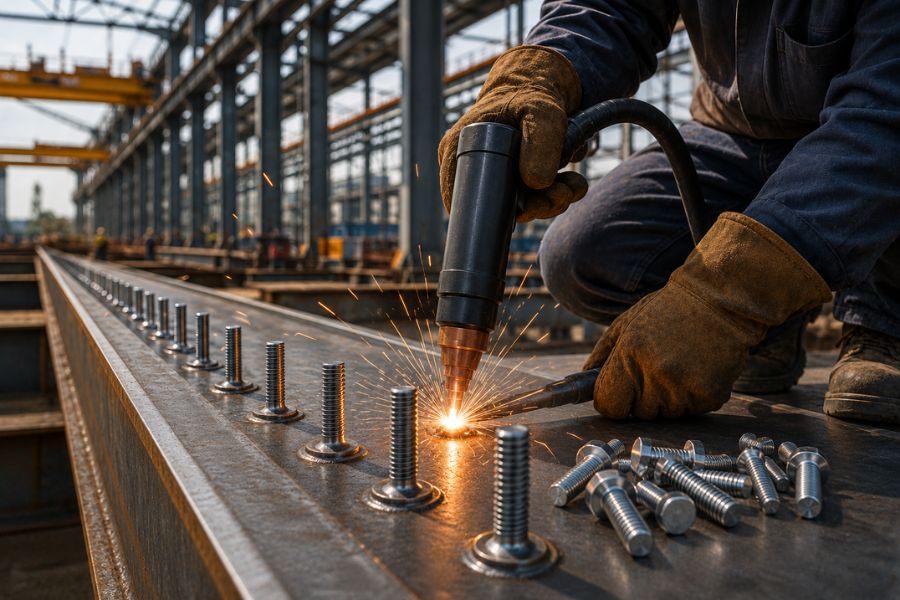
Drawn arc stud welding eliminates most of the cost drivers that make traditional fastening methods expensive on large projects. Here is how it does that across four key areas:
Speed per weld
A single drawn arc weld completes in under one second. A skilled operator can install hundreds of studs per hour using a standard stud welding gun. By contrast, a bolted connection requires drilling, cleaning, threading, inserting hardware, and torquing, a sequence that takes several minutes per point. Therefore, on a program with 500 connection points, the time savings from drawn arc welding alone can account for days of recovered labor.
Single-sided access
Drawn arc stud welding requires access to only one side of the base material. The weld completes from the face of the steel without any backing hardware, backing plates, or reverse-side access. This matters enormously in structural steel fabrication and bridge construction, where beam flanges and embedded plates are often accessible from one side only.
No material removal
Bolting removes material at every hole. Drawn arc welding adds material, the stud itself, without compromising the base metal’s cross-section. Consequently, the structural integrity of the base material remains fully intact at every weld point.
Inspection efficiency
Each drawn arc weld produces a visible flash ring that trained inspectors evaluate in seconds. Torque verification on bolted connections, by contrast, requires calibrated tools, documented results, and re-torquing on a percentage of fasteners. On large programs, the time difference in inspection alone justifies the equipment investment.
Where Drawn Arc Outperforms on Large Industrial Projects
The cost advantages of drawn arc stud welding compound as project scale increases. On smaller jobs with fewer than 50 connection points, the difference between methods may be marginal. However, on programs involving composite floor decks, bridge construction, structural steel fabrication, or construction equipment manufacturing, the comparison shifts decisively.
Consider a composite bridge deck project requiring 3,000 shear connectors. Installing each one with drawn arc welding takes under a second. Achieving the same connection with bolts would require drilling 3,000 holes, inserting and torquing 3,000 bolt assemblies, and verifying each one. The labor cost difference on that single program often exceeds the entire cost of the stud welding equipment used to complete it.
For fabrication shops that run high-volume programs regularly, investing in automation equipment takes this further. Automated drawn arc systems install studs with robotic precision at rates that a manual operation cannot match, while simultaneously reducing operator fatigue, improving weld consistency, and cutting per-unit labor costs dramatically.
Drawn Arc vs. CD Welding A Note on Scope
It is worth clarifying that this comparison focuses on structural and heavy industrial applications where drawn arc welding is the appropriate process. For lighter applications, sheet metal enclosures, food service equipment, thin-gauge panel assembly, capacitor discharge (CD) welding suits the work better. CD studs offer faster setup and cleaner results on thin materials where drawn arc heat input would cause burn-through.
Choosing between drawn arc and CD depends entirely on base material thickness and the load requirements of the connection. For anything involving structural steel, composite construction, or large-diameter studs, drawn arc remains the superior and most cost-effective choice.
Source Drawn Arc Supplies and Equipment from Northland Fastening Systems
We supply the full range of drawn arc stud welding products, threaded studs, headed anchors, shear connectors, deformed bar anchors, ceramic ferrules, and all standard arc accessories, in every diameter and length your project specification calls for. For product updates, industry insights, and company news, follow our Facebook page and Google Business Profile.
For teams evaluating equipment options, Northland Fastening Systems offers both rental and purchase programs, giving your operation the flexibility to scale up for large programs without a major upfront capital commitment. Our team works directly with project managers, estimators, and purchasing departments to match the right products to each application.
Call our team at 651-730-7770 today to speak with a product specialist and get your order right from the start.
Frequently Asked Questions
Q1: How much faster is drawn arc stud welding compared to bolting per connection?
A drawn arc weld completes in under one second per point. Bolting requires drilling, inserting, and torquing a process that typically takes several minutes per connection on structural steel.
Q2: Does drawn arc stud welding weaken the base material at the weld point?
No. Drawn arc welding adds material to the base steel without drilling or removing any metal. The base material’s structural cross-section stays fully intact at every weld point.
Q3: What is the minimum base material thickness for drawn arc stud welding?
As a general rule, the base material must be at least one-third the diameter of the stud being welded. For most structural applications, this means base material of 3/16 inch or thicker.
Q4: Can drawn arc stud welding replace bolting on certified structural projects?
Yes, when performed to AWS D1.1 specifications with certified materials and documented procedures. Drawn arc stud welding meets structural code requirements across construction, bridge, and fabrication applications.