Stud welding safety is a mandatory responsibility—not an optional checklist item. OSHA Standards 1910 Subpart Q and 1926 Subpart J govern welding operations in general industry and construction job sites, respectively, and both require active hazard control measures on every project. The drawn arc process generates intense UV radiation, high-amperage electrical current, spatter at temperatures exceeding 3,000°F, and fumes that can accumulate quickly in confined spaces. Northland Fastening Systems works with fabrication teams and construction contractors who run stud welding programs daily, and we know that strong safety practices protect both welders and production schedules. This guide covers every major hazard category and explains how to address each one.
Why Stud Welding Hazards Deserve Specific Attention
Many job sites treat stud welding as lower-risk than conventional welding because it completes in under one second. That assumption is dangerous. The drawn arc process generates the same hazardous outputs as conventional arc welding — UV radiation, electrical arc flash, metal spatter, and toxic fumes — in a fraction of the time. Because each weld cycle is so fast, operators perform dozens or hundreds of welds per shift. The cumulative exposure across a full shift is substantial.
Furthermore, the speed of the process means hazards occur repeatedly and rapidly. A welder who blinks at the wrong moment or positions their face too close to an unshielded arc zone faces the same photokeratitis risk — arc eye — as any conventional arc welder. UV radiation from an unprotected arc causes permanent corneal damage within seconds of exposure.
Stud Welding Safety Hazard Reference Table
Use this table as a quick reference for every primary hazard category in a drawn arc stud welding operation.
| Hazard | Source | Risk | Required Control |
|---|---|---|---|
| UV and IR radiation | Electric arc during weld cycle | Arc eye, skin burns | Welding helmet with the correct shade lens (minimum Shade 5) |
| Electrical shock | High-amperage welding circuit | Cardiac arrest, severe burns | Insulated gloves, dry work surface, and grounded equipment |
| Metal spatter | Molten weld pool during the arc phase | Burns to skin, eyes, and clothing | Full face shield, leather gloves, and flame-resistant clothing |
| Welding fumes | Vaporized base metal and stud material | Respiratory damage, metal fume fever | Adequate ventilation and a respirator in confined spaces |
| Fire and combustion | Spatter landing on combustible materials | Job site fire | Clear a 35-foot radius of combustible materials before welding. |
| Arc flash | Short circuit in the welding circuit | Severe electrical burns | Correct cable insulation and no bare conductors in the work area. |
| Noise | Repeated weld cycles in enclosed spaces | Hearing damage over time | Hearing protection in high-volume enclosed environments. |
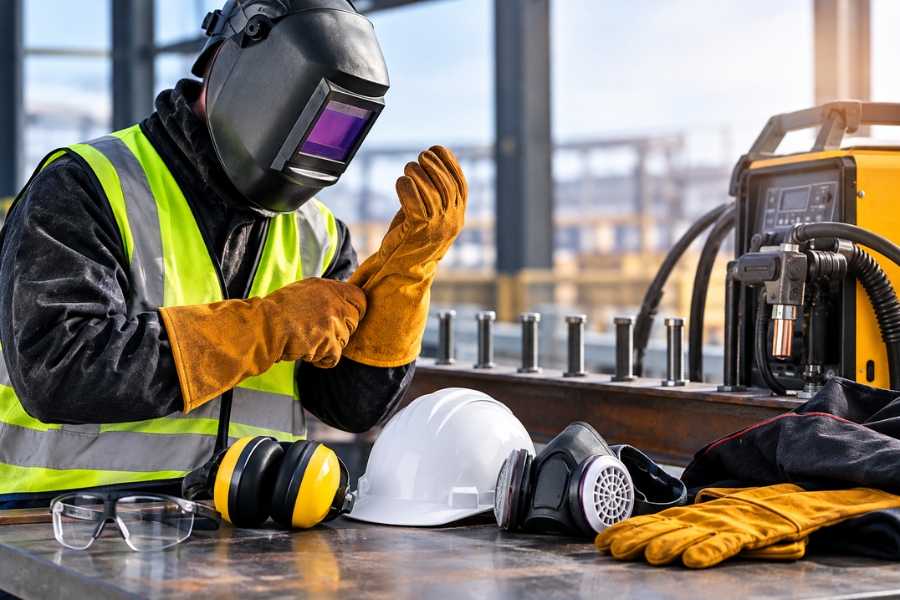
Personal Protective Equipment: What Every Stud Welder Must Wear
PPE is the last line of defense — not the first. However, it must be correct, fitted, and worn consistently on every weld cycle without exception.
Eye and face protection — A welding helmet with a minimum shade 5 lens is required for drawn arc stud welding. A shade 5 lens filters the UV and IR radiation produced during the arc phase. In addition, a full face shield worn over the helmet protects against spatter during high-volume production runs. Auto-darkening helmets that react within 1/25,000 of a second offer the best protection for fast-cycle stud welding operations.
Hand protection — Leather welding gloves protect against spatter and incidental contact with hot studs and ferrule fragments immediately after a weld. Thin work gloves are not acceptable substitutes — they do not provide adequate thermal protection at contact temperatures that can exceed 1,000°F on recently welded studs.
Body protection — Flame-resistant clothing covers all exposed skin on arms and torso. OSHA 1910.252 specifically requires that welders never work while wearing wet clothing or synthetic fabrics that melt under heat exposure. Natural fiber clothing — cotton, wool, or leather — provides significantly better protection against spatter burns.
Footwear — Leather boots with steel toes protect against falling studs, ferrule fragments, and incidental contact with hot materials on the work surface.
Electrical Safety: The Hazard Most Overlooked on Stud Welding Programs
The drawn arc process runs on direct current at high amperage — typically 400 to 2,000 amps depending on the stud diameter. At those levels, a fault in the welding circuit does not simply trip a breaker. It delivers a lethal electrical discharge.
Northland Fastening Systems always advises operators to inspect their complete welding circuit before beginning any production run. Check cable insulation for cracks, abrasion, or bare conductor exposure at every connection point. Confirm ground cable connection is solid and positioned correctly on the base material — a poor ground creates arc instability that operators often misattribute to machine calibration errors.
Furthermore, never modify the welding circuit while the machine is energized. Disconnect the power source before changing cables, chucks, or any component in the circuit. OSHA 1910.252 requires that welding machines be disconnected from the power source during any substantial work break — not just powered down.
Ventilation Requirements for Stud Welding Operations
Drawn arc welding vaporizes metal at the weld zone on every cycle. Each weld produces a small quantity of metallic fume — but across hundreds of welds per shift in an enclosed fabrication environment, that fume accumulates to hazardous concentration levels quickly.
OSHA requires adequate ventilation in all enclosed welding areas. In practice, this means mechanical exhaust ventilation positioned near the weld zone — not just open doors at the ends of a building. For confined space applications — interior ship compartments, enclosed structural frames, or tank interiors — a supplied-air respirator is required rather than a standard particulate mask.
Specifically, base metal coatings create additional fume hazards. Welding through galvanized steel produces zinc oxide fumes that cause metal fume fever — flu-like symptoms appearing within hours of exposure. Painted or coated surfaces release additional toxic compounds. Remove coatings from the weld zone before welding wherever possible and increase ventilation when removal is not practical.
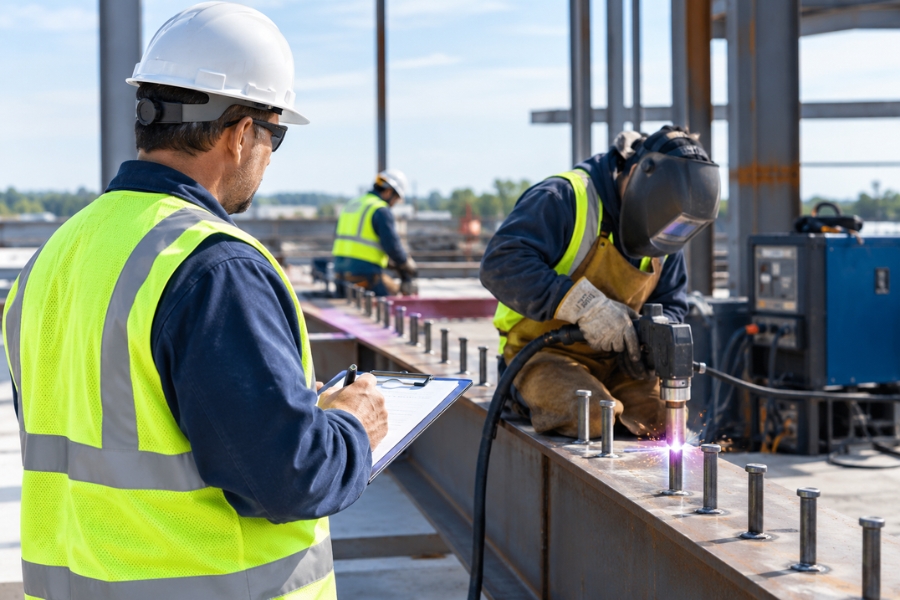
Supervisor Responsibilities on Stud Welding Job Sites
Safety compliance is not the welder’s responsibility alone. Supervisors carry specific obligations under OSHA standards that directly affect job site safety outcomes.
Before any stud welding program begins, supervisors must confirm the following:
All combustible materials are cleared from a 35-foot radius around the weld zone — an explicit OSHA requirement for hot work operations. Screens or curtains are positioned to protect any nearby workers from arc flash exposure. OSHA 1910.252 specifies that screens should be positioned approximately 2 feet above the floor to protect bystanders without restricting ventilation.
Operators have received task-specific safety training for the stud welding process — not just general welding safety orientation. The equipment has been inspected for cable insulation integrity, ground connection quality, and accessory condition before production begins.
Correct stud welding accessories — specifically chucks, ferrule grips, and spark shields — are installed and matched to the stud diameter being used. Worn or mismatched accessories increase spatter output and arc instability, both of which elevate safety risk on every weld cycle.
Choosing Equipment and Supplies That Support Safe Operations
The quality of your equipment and consumables directly affects safety outcomes on every shift. Well-maintained arc studs with correct ignition tip geometry produce stable, predictable arcs. Worn or off-spec studs produce erratic arcs that generate excessive spatter, increase operator exposure, and make the weld zone unpredictable.
Similarly, ceramic ferrules that match the stud diameter contain the weld pool correctly and direct spatter away from the operator. A mismatched or cracked ferrule allows molten metal to escape the weld zone in unpredictable directions — a direct safety hazard on every weld where it occurs.
Source Safe, AWS-Compliant Stud Welding Supplies from Northland Fastening Systems
Northland Fastening Systems supplies drawn arc studs, ceramic ferrules, chucks, cable accessories, and complete stud welding equipment — all meeting AWS compliance standards for structural and industrial applications. Every product we stock is designed to perform consistently within its rated specification, which directly supports predictable, safer weld cycles on every program.
Our team works directly with fabrication supervisors and project managers to confirm that equipment, accessories, and consumables are correctly matched before a production run begins. Call us at 651-730-7770 to speak with a product specialist today. We help your team set up correctly from the first weld — safely and on specification.
Frequently Asked Questions
Q1: What OSHA standards apply to stud welding safety on job sites?
OSHA 1910 Subpart Q covers welding safety in general industry environments. OSHA 1926 Subpart J applies to construction job sites. Both require PPE, ventilation, fire hazard control, and electrical safety measures on all welding operations including stud welding.
Q2: What lens shade is required for drawn arc stud welding?
A minimum shade 5 welding lens is required for drawn arc stud welding. The lens must filter UV and IR radiation produced during the arc phase. Auto-darkening helmets with a reaction time of 1/25,000 of a second provide the most consistent protection across rapid, repeated weld cycles.
Q3: How far must combustible materials be cleared before stud welding begins?
OSHA requires that all combustible materials be cleared from a 35-foot radius around the hot work zone before any welding begins. Materials that cannot be removed must be covered with fire-resistant blankets or shielding before work starts.
Q4: What ventilation is required for stud welding in confined spaces?
Confined space stud welding requires supplied-air respiratory protection — not a standard particulate mask. Mechanical exhaust ventilation positioned near the weld zone is required in all enclosed fabrication environments where fumes accumulate across a production shift.